Bestseller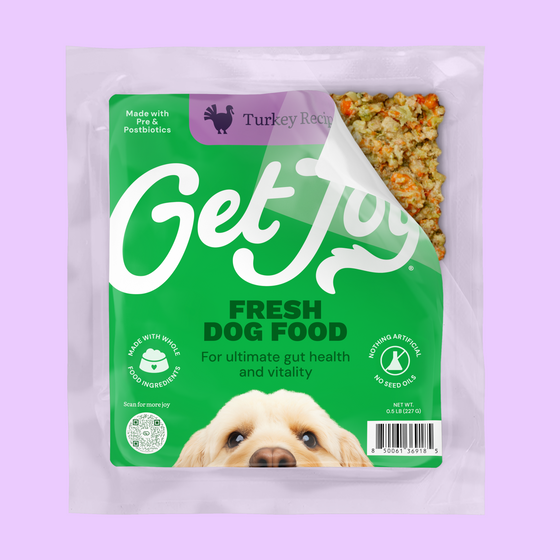
 Gut health
 Sensitive stomach
 Calm
Calm Joints & mobility
 Skin & coat
 Healthy weight
 Picky eaters



The Secret to Longevity for You and Your Dog: Healing the Gut
by Dan Buettner ・ 15 min readKey Takeaways
- The gut microbiome is the common thread between the world's longest-lived humans and the healthiest, longest-lived dogs.
- Blue Zones research consistently shows that microbiome diversity — driven by whole, minimally processed food — is a defining feature of populations that live the longest.
- A 2023 Nature Microbiology study found that dogs fed whole-food diets had significantly more diverse gut microbiomes than those fed ultra-processed kibble.
- Chronic, low-grade gut inflammation is one of the primary drivers of accelerated aging in dogs — and it's largely diet-driven.
- Get Joy's Freeze Dried Raw Meals include Belly Biotics™ — a built-in blend of prebiotics, probiotics, and postbiotics — making gut support a structural part of every bowl, not an afterthought.
In This Article
The Gut Is Where Longevity Starts
Over the past two decades, I've had the privilege of spending time in the places where people live the longest — Sardinia, Okinawa, Nicoya, Ikaria, and Loma Linda. The Blue Zones. I've sat at kitchen tables, walked through gardens, watched elders move through their mornings with an ease that confounds the actuarial tables.
What I kept finding, underneath every other explanation — the community, the purpose, the movement — was something more fundamental: a gut that worked. A microbiome that had been fed, consistently and generously, by real whole food over a lifetime.
I've been thinking about this a lot in relation to our dogs.
Dogs and humans share something remarkable: not just our homes and our routines, but the architecture of our digestive systems. We co-evolved. The same forces that compromised the human gut over the last century — ultra-processed food, diminished dietary diversity, an overreliance on convenience — have done the same thing to our dogs. And the consequences are showing up the same way: more inflammation, more chronic disease, shorter healthy lifespans than we should expect.
The good news is the same, too. Start with the gut, and you change the trajectory of everything else.
The Unsung Hero of Health: What Blue Zones Taught Me About the Microbiome
When I first began documenting the Blue Zones, the science of the gut microbiome was still emerging. We knew that the longest-lived people ate differently — more plants, more legumes, minimal processing, extraordinary variety. But we were still piecing together why that mattered so deeply at a biological level.
The microbiome answered a lot of those questions.
Centenarians in Sardinia carry strains of gut bacteria we rarely see in modern Western populations. Okinawans, whose traditional diet is anchored in purple sweet potato and fermented soy, show levels of microbiome diversity that correlate directly with lower rates of the inflammatory diseases that end lives early elsewhere. In Ikaria — the Greek island where people "forget to die," as a New York Times piece once put it — wild greens, olive oil, and legumes feed a microbial ecosystem that keeps systemic inflammation remarkably quiet well into old age.
This is not coincidence. The microbiome is where food becomes biology. It's where a diet either creates health downstream or quietly dismantles it. The bacteria in your gut don't just aid digestion — they regulate immunity, synthesize vitamins, produce anti-inflammatory compounds, and communicate directly with the brain. A diverse, well-nourished microbiome is one of the most powerful predictors of a long, healthy life that population science has identified.
And everything I've learned in Blue Zones research points to the same upstream driver: what you eat, consistently, over time.
Your dog's biology tells the same story.
What Science Says About Gut Health and Dog Longevity
The research on canine gut health has accelerated considerably in recent years, and the findings are striking in how closely they mirror what we've observed in human longevity populations.
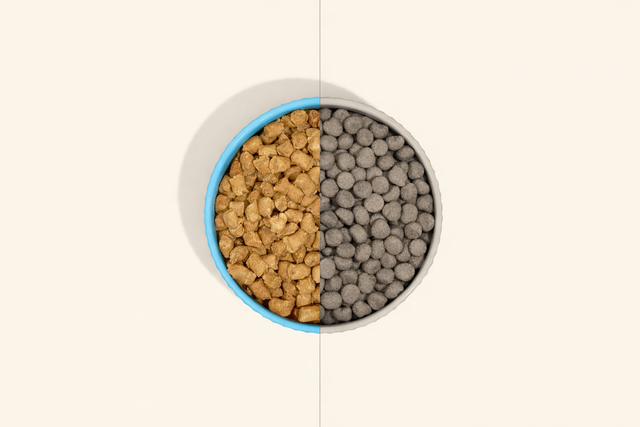
A landmark 2023 study published in Nature Microbiology examined the gut microbiomes of dogs across different dietary patterns. The findings were clear: dogs fed whole-food diets had significantly greater microbiome diversity than dogs fed ultra-processed commercial kibble. That diversity wasn't cosmetic — it was associated with better metabolic markers, stronger immune function, and reduced indicators of systemic inflammation.
Diversity matters because no single bacterial strain does everything. A rich microbial ecosystem — with hundreds of different species performing different functions — is a resilient one. It handles disruptions better. It produces a wider range of beneficial compounds. It maintains the intestinal barrier that keeps inflammatory particles out of the bloodstream.
When that barrier breaks down — a condition increasingly referred to as "leaky gut" — the consequences ripple outward. Chronic, low-grade inflammation is now understood to be one of the central mechanisms of accelerated aging in dogs. It underlies joint disease, cognitive decline, skin disorders, and metabolic dysfunction. It is not, in most cases, a genetic inevitability. It is, in large part, a dietary one.
This is important because it means it's addressable. The gut can be healed. The microbiome can be rebuilt. And food is the most powerful tool we have to do it.
Gut Health, Built Into Every Meal
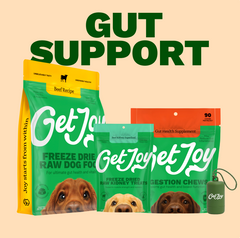
Get Joy's Freeze Dried Raw Meals include Belly Biotics™ — prebiotics, probiotics, and postbiotics — as a structural ingredient in every bowl. Not a sprinkle. The foundation.
Shop Freeze Dried Raw Meals →What Food Makes Dogs Live Longest?
In every Blue Zone I've studied, food is the most consistent differentiator. Not supplements. Not medical interventions. Not even genetics — which accounts for, at most, about 20 to 25 percent of longevity outcomes according to the best twin studies. Food. Consistent, daily food choices, compounding over a lifetime.
The parallel for dogs is direct. When we look at what the science supports for canine longevity, several patterns emerge:
Whole, minimally processed ingredients. Just as the centenarians I've spent time with eat food that looks like food — not something extruded, shelf-stabilized, and stripped of its original nutritional architecture — dogs thrive on ingredients that retain their natural nutrient density. Whole proteins. Recognizable vegetables. Real organ meats. The kind of food that comes from a kitchen, not a factory floor.
Fiber-rich vegetables. Dietary fiber is the primary fuel for beneficial gut bacteria. Without it, the microbial ecosystem starves. Blue Zones populations eat, on average, far more fiber than the modern Western norm — and their microbiomes are richer for it. Dogs benefit from the same principle. Sweet potato, pumpkin, leafy greens, and other fiber-dense vegetables feed the bacteria that produce short-chain fatty acids, reduce inflammation, and maintain gut barrier integrity.
Prebiotics and probiotics. In traditional food cultures, fermentation was a staple — not a trend. Fermented foods delivered live beneficial bacteria and the prebiotic substrates to sustain them. Modern dog diets, like modern human diets, have largely stripped this out. Restoring it matters. Prebiotics feed the good bacteria already present in the gut; probiotics introduce beneficial strains directly.
Anti-inflammatory ingredients. Chronic inflammation is the enemy of longevity. Ingredients like turmeric, omega-3-rich fish, and antioxidant-dense vegetables directly counter inflammatory pathways in the body. They don't just add nutrients — they change the gut environment in ways that make everything downstream function better.
The through-line is simplicity: give the gut what it evolved to work with, consistently, and it will do the rest.
What Goes Into Your Dog's Bowl Matters: Belly Biotics™ Explained
One of the things that struck me when I first learned about Get Joy's approach was how structurally similar it is to the food philosophies I've documented in Blue Zones communities.
In Ikaria, a traditional meal isn't designed around a single superfood. It's built as an ecosystem — multiple ingredients working together, each contributing something the others can't. That integrated approach is what makes it powerful. Pull any single element out and the whole system loses something.
Get Joy's Freeze Dried Raw Meals are designed with the same logic. Belly Biotics™ — the brand's proprietary blend of prebiotics, probiotics, and postbiotics — isn't a topping or an add-on. It's built into the meal itself. It's structural.
Here's what each component does:
Prebiotics are the fibers and compounds that feed beneficial gut bacteria. Think of them as the soil — they create the conditions in which a healthy microbiome can take root and thrive. Without adequate prebiotics, even the best probiotic strains struggle to establish themselves.
Probiotics are live beneficial bacteria that are introduced directly into the gut. They compete with harmful pathogens for space and resources, produce beneficial compounds, and reinforce the mucosal lining of the intestine. Different strains perform different functions — which is why strain diversity matters, not just quantity.
Postbiotics are the bioactive compounds produced when probiotics ferment prebiotic fibers — short-chain fatty acids, bacteriocins, and other metabolites that have direct anti-inflammatory and immune-modulating effects. They are, in a sense, the output of a healthy microbiome doing its job. Including them directly means the gut gets the benefit even before its own microbial ecosystem has fully adapted.
Together, these three work as a system — each one supporting the others. That's the Blue Zones parallel I keep coming back to. Longevity isn't produced by one thing. It's produced by an interlocking set of things that, together, create an environment where health compounds over time.
Food is where that environment is built, one bowl at a time. You can learn more about how gut health underpins everything at Get Joy's Gut Health 101 →
Healthier Gut. Healthier Life.
I've spent years telling people that longevity isn't something that happens to you — it's something you build, through the daily choices that either support health or slowly erode it. The longest-lived people on earth didn't find a secret. They just lived in environments where the easy choice was consistently the right one.
We can do that for our dogs.
We control what goes in the bowl. That's enormous power — and enormous responsibility. The food your dog eats today shapes the gut microbiome it will have tomorrow, and next year, and ten years from now. The inflammation it avoids now is the joint disease it won't have at nine. The microbial diversity it builds now is the immune resilience it carries into old age.
A healthier gut is not a niche concern or a wellness trend. It is, the science is increasingly clear, where a longer and more joyful life together begins.
Start there. The rest follows.
Related Reading
Give Their Gut the Foundation It Deserves
Every bowl of Freeze Dried Raw Meals includes Belly Biotics™ — built in, not sprinkled on. Real food, real function, real results.
Shop Freeze Dried Raw Meals Learn About Gut Health →Browse More Topics

Written by
Dan Buettner
Shop by Concern


Featured Posts
Keeping Your Dog Healthy in Winter: Cold Weather, Immunity, and Gut Health
The Best Dog-Safe Christmas Treats (Store-Bought and Homemade)