Bestseller

 Gut health
 Sensitive stomach
 Calm
Calm Joints & mobility
 Skin & coat
 Healthy weight
 Picky eaters



Preventative Care for Dog Joint Health: The Joint+ Supplement and More
by The Get Joy Food Team ・ 18 min readLast updated: May 2026
Key Takeaways
- Joint disease — including osteoarthritis, hip dysplasia, and elbow dysplasia — affects an estimated 1 in 5 dogs. Most of the damage accumulates silently before any limp appears.
- Chronic systemic inflammation is the primary driver of cartilage degradation. Gut dysbiosis (an imbalanced microbiome) is one of the leading, and most overlooked, sources of that inflammation.
- Targeted supplement ingredients — glucosamine, chondroitin, MSM, omega-3s, green-lipped mussel, and curcumin — have strong evidence behind them. Get Joy's Joint Supplement combines them in one daily chew.
- Weight, exercise quality, and nutrition are the three most powerful levers you control. Even modest weight loss meaningfully reduces joint load.
- Belly Biotics™, Get Joy's built-in prebiotic, probiotic, and postbiotic blend, supports a healthy gut microbiome — which in turn helps calm the systemic inflammation that accelerates joint degeneration.
Most Affected Breeds: Large and giant breeds are most affected: German Shepherds, Labrador Retrievers, Golden Retrievers, Rottweilers, Great Danes, Saint Bernards, Bernese Mountain Dogs. All breeds benefit from joint-supportive nutrition.
One in five dogs will develop joint disease in their lifetime. For large breeds, the number climbs to nearly one in two. And yet most dogs show no obvious signs — no limp, no yelp — until significant cartilage loss has already occurred.
That is the cruel math of joint degeneration: the damage is quiet, cumulative, and largely irreversible. The window to make a real difference is not when your dog is slowing down. It is now, while their joints are still intact and the inflammation driving the damage is still stoppable.
This guide covers everything you need to know — the types of joint disease, the risk factors, the warning signs your dog can't tell you about, the role of gut health, the supplement ingredients with the strongest evidence, and what Get Joy is doing differently to support dogs from the inside out.
Types of Dog Joint Disease
Not all joint problems are the same. Understanding the differences helps you know what you are protecting against — and why early action matters.
Osteoarthritis (OA)
Osteoarthritis is the most common joint condition in dogs, affecting an estimated 20% of dogs over one year of age. It is a degenerative disease in which the protective cartilage covering the ends of bones gradually wears away. Without that cushion, bone grinds against bone, producing inflammation, pain, and progressive loss of mobility. OA has no cure — once cartilage is gone, it does not grow back — which is why prevention is the only genuinely effective strategy.
Hip Dysplasia
Hip dysplasia is a malformation of the hip joint in which the ball and socket do not fit or develop properly. It has a strong genetic component but is heavily influenced by growth rate, body weight, and nutrition during development.
Elbow Dysplasia
Elbow dysplasia is a group of developmental conditions affecting the elbow joint. It is most common in large and giant breeds and is a leading cause of foreleg lameness in young dogs.
Luxating Patella
A luxating patella occurs when the kneecap slides out of its normal position. It is the most common orthopedic condition in small and toy breeds.
Ligament Injuries (CCL Tears)
Cranial cruciate ligament (CCL) tears are among the most common orthopedic injuries in dogs. They are frequently the result of cumulative ligament degeneration rather than a single traumatic event, meaning diet, weight, and systemic inflammation contribute to the risk.
Risk Factors: Which Dogs Are Most Vulnerable?
Joint disease does not discriminate, but some dogs carry a significantly higher burden of risk. Knowing your dog's risk profile lets you get ahead of the problem before it starts.
Breed
- Large and giant breeds (German Shepherds, Golden Retrievers, Labrador Retrievers, Rottweilers, Great Danes, Saint Bernards) — high risk for hip and elbow dysplasia and osteoarthritis
- Small and toy breeds (Chihuahuas, Pomeranians, Pugs, Shih Tzus) — high risk for luxating patella
- Athletic working breeds (Border Collies, Australian Shepherds, Labrador Retrievers) — elevated CCL tear risk
Body Weight
Excess weight is one of the most powerful and modifiable risk factors for joint disease. Every extra pound adds roughly four to five pounds of pressure on the joints with each stride. Even a 6–8% reduction in body weight has been shown to produce measurable improvements in mobility and pain scores.
Age
The risk of degenerative joint disease increases with age, but the underlying damage accumulates throughout life. The most effective interventions happen years before the first limp.
Growth Rate in Large Breeds
Rapid early growth in large-breed puppies is a well-established risk factor for developmental orthopedic disease. Feeding large-breed puppies a diet calibrated for controlled growth substantially reduces this risk.
Activity Level and Type
High-impact, repetitive activity accelerates wear on cartilage over time. Consistent, controlled, low-impact movement is protective; intermittent extreme activity is not.
Warning Signs to Watch For
Dogs are stoic animals. By the time they show obvious pain, joint disease is often well advanced. Knowing the subtle early signals gives you a fighting chance to intervene sooner.
Stiffness After Rest
One of the earliest signs of joint disease is stiffness when your dog first gets up after sleeping or lying down. This pattern — worse in the morning, improving with gentle movement — is classic for osteoarthritis.
Reluctance to Use Stairs or Jump
If your dog suddenly hesitates at the bottom of the stairs, refuses to jump into the car, or avoids furniture they previously enjoyed, pay attention. This is a protective response to joint pain.
Lameness or Altered Gait
Visible limping is an obvious flag, but subtle changes in gait — a slight head bob, an asymmetric stride, carrying weight differently — can appear before full limping develops.
Reduced Activity and Exercise Intolerance
A dog that used to run the full length of a walk and now lags behind may be experiencing joint pain. Activity intolerance is one of the most reliable early behavioral indicators.
Behavioral Changes
Pain changes personality. Dogs in joint pain may become more irritable, reactive, or withdrawn. Decreased interest in play, increased sleeping, and reduced social engagement are all worth noting.
When to call your vet: Any of the above signs warrant a conversation with your veterinarian. Early diagnosis and intervention significantly improves long-term outcomes.
The Inflammation-Joint Connection
Chronic systemic inflammation disrupts the balance of cartilage repair and breakdown. Inflammatory cytokines directly stimulate the enzymes that break down cartilage, while suppressing cells responsible for repair. This is why joint health cannot be reduced to cartilage supplements alone.
Sources of chronic systemic inflammation in dogs include:
- Excess body fat (adipose tissue is metabolically active and pro-inflammatory)
- Poor-quality diet high in refined carbohydrates and omega-6 fatty acids
- Environmental toxins and chronic low-grade exposures
- Gut dysbiosis — an imbalanced intestinal microbiome
How Gut Health Drives Joint Inflammation
The gut microbiome plays a central role in regulating immune function and systemic inflammatory tone. When the microbiome is disrupted, the intestinal lining becomes more permeable. Bacterial components leak into the bloodstream, triggering systemic inflammation that reaches joint tissue and accelerates cartilage degradation.
Supporting your dog's gut microbiome is not just about digestion. It is a meaningful strategy for protecting their joints.
This is the thinking behind Get Joy's approach. Our Belly Biotics™ blend — a built-in combination of prebiotics, probiotics, and postbiotics — is formulated to support a balanced, resilient gut microbiome. Not as a sprinkle-on add-on, but as a structural part of every meal.
Joy starts from within.
Get Joy's Freeze Dried Raw Meals include Belly Biotics™ — our proprietary prebiotic, probiotic, and postbiotic blend — built directly into the food. Support gut health with every meal, and reduce the systemic inflammation that accelerates joint degeneration.
Shop Freeze Dried Raw Meals The Active Dog BundleKey Supplement Ingredients — and What They Do
Glucosamine HCl
Glucosamine is an amino sugar that serves as a building block for cartilage, synovial fluid, and connective tissue. The HCl form is the most bioavailable. It is one of the most studied and widely recommended joint supplements in veterinary and human medicine.
Chondroitin Sulfate
Chondroitin helps cartilage retain water and resist compression, and inhibits enzymes that break down cartilage matrix. It works best in combination with glucosamine.
MSM (Methylsulfonylmethane)
MSM is an organic sulfur compound with anti-inflammatory and antioxidant properties. It supports connective tissue, collagen, and cartilage formation, and has been shown to reduce inflammatory markers and improve mobility in dogs.
Omega-3 Fatty Acids (EPA and DHA)
EPA and DHA from fish oil and marine sources are among the most evidence-backed anti-inflammatory nutrients available. In dogs with osteoarthritis, supplemental omega-3s have been associated with improved weight-bearing and measurable improvements in mobility assessments.
Green-Lipped Mussel (GLM)
Green-lipped mussel is uniquely rich in ETA omega-3s, glycosaminoglycans, chondroitin, and trace minerals. Multiple clinical trials in dogs have demonstrated improvements in joint mobility, pain, and overall function with GLM supplementation.
Turmeric / Curcumin
Curcumin inhibits inflammatory signaling pathways (including NF-κB and COX-2) targeted by conventional anti-inflammatory drugs, without the associated side effects.
Ginger Root Extract
Ginger contains gingerols and shogaols with demonstrated anti-inflammatory and analgesic properties, and has a long history of use for joint and digestive support.
Egg Membrane Collagen
The eggshell membrane is naturally rich in collagen, hyaluronic acid, glucosamine, chondroitin, and elastin — the full structural toolkit for connective tissue and cartilage.
Betaine
Betaine supports methylation, a key biochemical process involved in tissue repair and inflammation regulation.
Get Joy's Joint Supplement
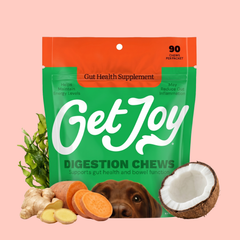
Get Joy's Joint Supplement was developed alongside PhD Animal Nutritionists to bring together the ingredients with the strongest evidence in a single daily chew — without artificial ingredients, fillers, or preservatives.
The formula includes: Glucosamine HCl, MSM, Green-Lipped Mussel, EPA & DHA, Egg Membrane Collagen, Ginger Root Extract, and Betaine.
As always, consult your veterinarian before starting your dog on any new supplement.
Learn more about Get Joy's Joint Supplement →
Nutrition for Joint Health
Anti-Inflammatory Whole Food Diet
A diet built around whole, minimally processed ingredients provides a broader spectrum of anti-inflammatory nutrients. Get Joy's Freeze Dried Raw Meals are formulated around this principle, with real whole food ingredients and no filler.
Weight Management
Keep your dog lean. A body condition score (BCS) of 4–5 out of 9 is the target for most dogs. The relationship between excess body weight and joint disease is dose-dependent.
Protein Quality and Bioavailability
High-quality, bioavailable protein supports muscle mass, which in turn supports joint stability. Protein from whole meat sources is generally more bioavailable than protein from plant or rendered sources.
Exercise: The Right Kind Matters
What Helps
- Daily leash walks on softer surfaces — maintains range of motion and promotes synovial fluid circulation
- Swimming and hydrotherapy — the single best exercise for dogs with existing joint disease
- Short, consistent sessions over long, irregular ones — consistency is more protective than intensity
What to Moderate
- High-impact activities on hard surfaces, especially for large breeds and senior dogs
- Repetitive jumping on or off furniture or into vehicles
- Forced long runs or hikes for dogs showing any early joint symptoms
Related Reading
- Gut Health 101: Why the Microbiome Is the Foundation of Your Dog's Health
- Exercise and Joint Health: 4 Tips for Keeping Your Dog Active and Agile
- Dog Weight Management: A Complete Guide
Frequently Asked Questions
At what age should I start my dog on a joint supplement?
For large and giant breeds, many veterinarians recommend starting joint support by 12–18 months of age. For smaller breeds at lower risk, beginning support around 5–6 years of age is common.
Can joint supplements reverse existing arthritis?
No. Osteoarthritis is not reversible — lost cartilage does not regenerate. What joint supplements can do is slow the rate of degeneration, reduce inflammation, support pain management, and improve quality of life.
How long does it take to see results from a joint supplement?
Most veterinarians recommend a minimum 4–6 week trial period. Consistency is essential — intermittent use is unlikely to produce meaningful benefits.
What is the connection between gut health and joint health?
A healthy gut microbiome helps regulate systemic inflammatory tone. When disrupted, it can lead to increased intestinal permeability and elevated systemic inflammation that directly accelerates cartilage degradation.
Does Get Joy's Joint Supplement work alongside the meals?
Yes — the Joint Supplement is designed as a targeted layer of support that complements Get Joy's meal platform. The meals provide the nutritional foundation through Belly Biotics™; the Joint Supplement adds specific structural and anti-inflammatory support.
Should I consult my vet before starting a joint supplement?
Always. This is especially important if your dog is taking any medications, has a diagnosed health condition, or is scheduled for surgery.
Your dog's joints are worth protecting now — not when the limp starts.
Get Joy's Joint Supplement + Freeze Dried Raw Meals with Belly Biotics™ give your dog comprehensive joint support from the inside out.
Shop the Joint Supplement Shop Freeze Dried Raw Meals The Active Dog Bundle
Browse More Topics
Shop by Concern


Featured Posts
Keeping Your Dog Healthy in Winter: Cold Weather, Immunity, and Gut Health
The Best Dog-Safe Christmas Treats (Store-Bought and Homemade)