Bestseller
 Gut health
 Sensitive stomach
 Calm
Calm Joints & mobility
 Skin & coat
 Healthy weight
 Picky eaters



Beef Liver, Heart & Kidney for Dogs: Benefits + the 10% Rule
by The Get Joy Food Team ・ 23 min readLast Updated: July 1, 2026
Yes — organ meats are among the most nutritionally dense foods your dog can eat. Beef liver, heart, and kidney pack more vitamins, minerals, and functional nutrients per ounce than almost any other ingredient you can add to a bowl. But there’s an important rule that every dog parent needs to know before they start feeding them, and ignoring it can cause real harm.
The rule is simple: organ meats should make up no more than 10% of your dog’s total daily intake, and liver specifically should stay closer to 5%. The nutrients that make organ meats so powerful — especially Vitamin A and copper in liver — are also the ones that accumulate in the body and become toxic in excess. Get the amounts right and organ meats are extraordinary. Get them wrong and you’re working against your dog’s health, not for it.
🐾 Key Takeaways
- Organ meats are among the most nutrient-dense foods for dogs, but are best fed in controlled amounts — no more than 10% of daily intake.
- Beef liver is rich in Vitamin A, iron, and essential amino acids — but Vitamin A accumulates in the body, making moderation non-negotiable.
- Beef heart is an excellent source of CoQ10 and B vitamins, supporting cardiovascular health and cellular energy.
- Beef kidney is high in selenium, zinc, and essential fatty acids, supporting the body’s own detoxification pathways and skin health.
- Rotate organ meats to help avoid single-nutrient excess and always stay within the 10% daily rule.
Table of Contents
- Why organ meats are different from muscle meat
- Beef liver — the nutrient powerhouse (and the caution)
- Beef heart — the CoQ10 superfood
- Beef kidney — the detox supporter
- The 10% Rule — why it matters and how to apply it
- Vitamin A toxicity — what dog parents need to know
- How to rotate organ meats safely
- Frequently Asked Questions
Why Organ Meats Are Different From Muscle Meat
When most people think about protein for dogs, they think chicken breast, ground beef, or turkey — standard muscle meat. Muscle meat is great: it’s high in protein, contains essential amino acids, and is easy to digest. But it’s nutritionally shallow compared to organ meat.
Organ meats — liver, kidney, heart, spleen, pancreas — are metabolically active tissues. They do the biochemical heavy lifting inside the animal’s body: filtering blood, producing hormones, regulating energy. That metabolic activity requires dense concentrations of vitamins, minerals, enzymes, and cofactors that the organ tissue itself accumulates and stores.
The result is a class of food that is, ounce for ounce, far more nutrient-rich than muscle meat. Beef liver, for example, contains more Vitamin A than almost any other food on earth. It’s extremely high in B12, folate, iron, copper, and essential amino acids. This is why traditional diets — both for humans and working dogs — included organ meats as prized food, not scraps.
The freeze-drying process preserves most of the nutritional value of organ meats without requiring cooking, refrigeration, or artificial preservatives. Single-ingredient freeze-dried organ treats — like those Get Joy offers for liver, heart, and kidney — deliver whole-food nutrition in a convenient, shelf-stable form with a 2-year shelf life.
| Organ | Standout nutrients | What it supports | Feeding note |
|---|---|---|---|
| Beef Liver | Vitamin A, iron, copper, B12, folate | Vision, immune function, red blood cell production | Hold to ~5% of daily intake — Vitamin A & copper accumulate |
| Beef Heart | CoQ10, B vitamins, complete protein | Cardiovascular health, cellular energy | Technically muscle — lower accumulation risk than liver |
| Beef Kidney | Selenium, zinc, essential fatty acids | Skin & coat, the body’s own detox pathways | Rotate rather than feed daily — selenium can build up |
All three fit within the 10% daily organ-meat guideline. Rotating them keeps the nutrient profile varied and supports gut-first, whole-body nutrition.
Beef Liver — The Nutrient Powerhouse (and the Caution)
Beef liver is arguably the most nutritionally complete single food you can add to your dog’s diet. The nutrient profile is remarkable:
- Vitamin A: Liver is one of the richest natural sources of retinol (preformed Vitamin A) available. Critical for vision, immune function, skin health, and cellular differentiation.
- Iron: Heme iron from liver is highly bioavailable — far more so than the non-heme iron in plant sources. Supports red blood cell production and oxygen transport.
- B12 and folate: Essential for nerve function and DNA synthesis. Liver contains extraordinarily high levels of both.
- Copper: Liver is the highest dietary source of copper. Copper is essential for iron metabolism, connective tissue formation, and pigmentation — but excess copper accumulates in the liver and can contribute to serious liver disease, particularly in breeds prone to copper storage disorders.
- Essential amino acids: High-quality complete protein that supports muscle development, immune function, and tissue repair.
The nutrient density of liver is also why moderation is non-negotiable. Vitamin A is fat-soluble, which means it doesn’t flush out through urine the way water-soluble vitamins do. It accumulates in body fat and the liver. Too much, over time, can lead to toxicity — a real and documented condition in dogs. Copper behaves similarly and poses special risk for breeds with genetic copper metabolism issues (Bedlington Terriers, Labrador Retrievers, Dobermans, and others).
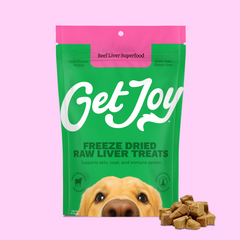
Get Joy’s freeze-dried beef liver treats are single-ingredient, USDA-sourced, with no seed oils, no artificial additives, and nothing else in the bag. They’re designed to be used as high-value training rewards or occasional toppers — not meal replacements.
Beef Heart — The CoQ10 Superfood
Technically speaking, heart is classified as muscle meat rather than organ meat — it’s a very hard-working cardiac muscle. But nutritionally, it sits in a category of its own, delivering a profile that standard skeletal muscle meat can’t match.
The standout nutrient in beef heart is Coenzyme Q10 (CoQ10). CoQ10 is an antioxidant compound that plays a central role in cellular energy production — specifically, in the mitochondrial electron transport chain, which generates ATP (the energy currency of every cell in the body). Heart tissue has among the highest concentrations of CoQ10 of any food source, because the heart muscle is always working and requires an exceptional level of cellular energy support.
For dogs, CoQ10 from dietary sources supports:
- Cardiovascular health and heart muscle efficiency
- Cellular energy production, particularly relevant for active and working dogs
- Antioxidant protection against oxidative stress
- Immune system resilience
Beef heart is also rich in B vitamins — particularly B12, B6, riboflavin, and niacin — which support energy metabolism, red blood cell production, and nervous system function. It’s a complete protein with all essential amino acids, and it’s highly palatable — most dogs find it extremely appealing as a training treat or topper.
Because heart is technically muscle rather than organ, it carries somewhat lower risk for the nutrient accumulation concerns associated with liver and kidney. That said, it still counts toward the total protein and fat load of your dog’s diet, and should be used within sensible daily limits.
Beef Kidney — The Detox Supporter
Beef kidney occupies a specific and underappreciated niche in organ nutrition. Its nutrient profile is distinct from liver and heart, making it a valuable addition when rotating organ meats.
Key nutrients in beef kidney:
- Selenium: A powerful antioxidant mineral that supports thyroid function, immune health, and protection against oxidative damage. Kidney is one of the richer dietary sources of selenium available.
- Zinc: Essential for skin integrity, wound healing, immune function, and enzyme activity throughout the body. Dogs with recurring skin or coat issues often benefit from improved zinc status.
- Essential fatty acids: Kidney contains a meaningful amount of fat, including essential fatty acids that support coat quality and skin health.
- B vitamins: Similar to heart, kidney provides riboflavin, B12, and other B vitamins supporting energy metabolism.
- Iron: Heme iron in bioavailable form, supporting oxygen transport.
The “detox supporter” label for kidney refers to its role in the animal it came from — kidneys filter blood and eliminate waste products — not to any detoxification role it plays in your dog’s body after consumption. What kidney does offer is a nutrient set (selenium, zinc, B vitamins) that supports your dog’s own detoxification pathways and overall metabolic health.
Single-Ingredient Organ Treats, Done Right
Get Joy’s freeze-dried beef liver, heart, and kidney treats are USDA-sourced, seed oil free, and nothing else. Perfect as training rewards or toppers — within the 10% rule.
The 10% Rule — Why It Matters and How to Apply It
The 10% rule is one of the most widely cited guidelines in raw and whole-food dog nutrition, and for good reason: it reflects the natural proportion of organ meat in a whole-prey diet, adjusted for the much higher concentration of certain nutrients in domestically sourced organ meats.
The rule: Organ meats (combined) should make up no more than 10% of your dog’s total daily caloric or weight intake. Liver specifically should be held closer to 5% because of its extremely high Vitamin A and copper content.
Here’s what that looks like in practice:
- A 30 lb dog eating approximately 8 oz (227g) of food daily should get no more than ~0.8 oz (23g) of organ meat total
- Of that, no more than ~0.4 oz (11g) should be liver
- The rest can be heart, kidney, or other organs
If you’re using freeze-dried organ treats, the dehydration process concentrates the food significantly — freeze-dried organ typically loses about 70–80% of its weight in water. A treat that weighs 5g freeze-dried may represent 15–20g of fresh organ. This means freeze-dried organs are even more potent than fresh weight suggests, and serving sizes should be adjusted accordingly.
Organ treats work beautifully as high-value training rewards — small pieces of liver or heart are extremely motivating for most dogs. They also work as occasional meal toppers within the 10% limit. What they’re not designed for is to replace a complete balanced meal or to be fed in large amounts as a protein source.
Vitamin A Toxicity — What Dog Parents Need to Know
Symptoms of Vitamin A toxicity in dogs include:
- Loss of appetite
- Weight loss
- Lethargy and weakness
- Joint pain and reluctance to move
- Stiffness, particularly in the neck and front legs
- Bone abnormalities (new bone growth on vertebrae and long bones)
- In severe cases: liver damage and organ failure
The risk is highest when liver is fed in large amounts on a regular basis — not from occasional treat use within the 10% guideline. A dog who gets a small piece of freeze-dried liver as a training treat several times a day, staying within 5% of total intake, is generally not at meaningful risk. A dog whose owner is feeding liver as a primary protein source or using it as a heavy meal topper is at greater risk over time.
The same principle applies to copper: excess copper from liver is a known contributor to hepatic copper accumulation, particularly in genetically susceptible breeds. If your dog has been diagnosed with or is at elevated risk for copper storage disease, speak with your veterinarian before feeding liver.
How to Rotate Organ Meats Safely
Rotation is the key to getting the benefits of multiple organ meats while managing the risk of any single nutrient accumulating to problematic levels. Here’s a practical approach:
Rotate the type of organ. Don’t use liver every day. Alternate between liver, heart, and kidney across the week. A simple pattern: liver 2 days, heart 3 days, kidney 2 days — all within the 10% daily limit. This spreads out the Vitamin A and copper load from liver while delivering the CoQ10 from heart and selenium from kidney.
Rotate the protein source, too. If you’re using beef liver, consider alternating with chicken liver (lower in copper than beef), duck heart, or lamb kidney. Different species means different nutrient profiles, which further distributes the load and adds variety to your dog’s diet.
Start low and go slow. Dogs new to organ meat — especially those who have been eating primarily kibble — may experience digestive upset (loose stools, gas) when organ meat is introduced. Start with small amounts, even well below the 10% limit, and increase gradually over 2–3 weeks as your dog’s digestive system adapts.
Count everything. If your dog’s main diet already includes organ meat as an ingredient — many fresh and raw food brands include liver in their recipes — then any organ treats you add on top need to be counted against the 10% limit. It’s a cumulative cap, not a per-source cap.
Frequently Asked Questions
How much beef liver can I give my dog per day?
Beef liver should make up no more than 5% of your dog’s total daily food intake because of its extremely high Vitamin A and copper content. For a 30 lb dog eating roughly 8 oz of food per day, that’s approximately half an ounce (14g) of fresh liver, or significantly less freeze-dried (since freeze-drying concentrates the food). Start at the low end and use liver as a treat or small topper, not a primary protein source.
Is beef heart considered an organ meat?
Technically, heart is cardiac muscle rather than organ meat — it’s a constantly working muscle rather than a metabolic organ like liver or kidney. Nutritionally, however, it’s distinct from standard skeletal muscle meat and is often grouped with organs in whole-prey nutrition discussions. It’s exceptionally rich in CoQ10 and B vitamins, and it’s generally considered safe in slightly larger amounts than liver because it doesn’t carry the same Vitamin A accumulation risk.
Can I feed organ meat every day?
You can include organ meat daily — in fact, small daily amounts of varied organ meat is a reasonable pattern — as long as you stay within the 10% total daily limit and rotate the types you’re using. What you want to avoid is feeding large amounts of the same organ (particularly liver) every single day, which is how Vitamin A and copper accumulation becomes a risk over time.
What breeds should be cautious about beef liver?
Breeds with known genetic susceptibility to copper storage disease should be particularly cautious: Bedlington Terriers, West Highland White Terriers, Labrador Retrievers, Doberman Pinschers, and Dalmatians are among the most commonly cited. If your dog is a breed on this list or has been diagnosed with elevated liver copper levels, consult your veterinarian before incorporating beef liver into the diet regularly.
Are freeze-dried organ treats as nutritious as fresh organ meat?
Freeze-drying preserves most of the nutritional value of organ meats by removing moisture at low temperatures without heat — unlike cooking, which can degrade heat-sensitive nutrients like B vitamins and enzymes. The key difference is concentration: freeze-dried organs have had most of their water removed, so they’re more nutrient-dense per gram than fresh. This means you need smaller amounts to deliver equivalent nutrition — and that serving size adjustments are important when converting from fresh to freeze-dried guidelines.
USDA-Sourced. Single Ingredient. Nothing Else.
Get Joy’s freeze-dried organ treats are made from one thing: real beef, sourced with care, freeze-dried to preserve every nutrient. No seed oils, no fillers, no artificial anything.
Browse More Topics
Shop by Concern


Featured Posts
Keeping Your Dog Healthy in Winter: Cold Weather, Immunity, and Gut Health
The Best Dog-Safe Christmas Treats (Store-Bought and Homemade)