Bestseller
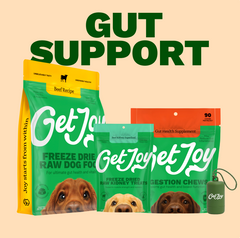
 Gut health
 Sensitive stomach
 Calm
Calm Joints & mobility
 Skin & coat
 Healthy weight
 Picky eaters



Pet Nutrition is the Foundation
by Tom Arrix ・ 26 min readLast updated: May 2026
Key Takeaways
- Nutrition is the single most controllable factor in your dog's long-term health — and it starts in the gut.
- Gut health is whole-body health: a thriving microbiome supports immunity, digestion, energy, coat, mood, and more.
- High-quality ingredients — real proteins, whole vegetables, healthy fats, complex carbs, no artificial additives — are the baseline, not a premium upgrade.
- Transitioning to better food doesn't have to be hard. A simple 4-week mix-in approach reduces digestive disruption and builds lasting habits.
- Get Joy's Freeze Dried Raw Meals include Belly Biotics™ — prebiotics, probiotics, and postbiotics — built directly into every bowl as a structural ingredient.
Most Affected Breeds: All breeds; every dog benefits from better nutrition.
Why Nutrition Matters More Than Anything Else
About three and a half years ago, I watched nutrition change my dog's life. She was sick — struggling with recurring digestive issues, low energy, a dull coat, and the kind of malaise that made every vet visit feel like a dead end. We'd tried treatments, supplements, vet-recommended foods. Nothing stuck. Then we changed what she ate. Really changed it. Within weeks, I saw a different dog.
That experience didn't just inspire Get Joy. It became the company's entire reason for being.
I'm not a veterinarian. I'm a dog parent who got frustrated enough to start asking the right questions — and obsessed enough to build something better when the answers weren't good enough. What I learned is this: of all the things you can do for your dog's health, what you feed them is the most powerful lever you have.
You can't always control genetics. You can't always prevent illness. But you can control what goes in the bowl, every single day. And over time, that daily decision compounds into either a foundation of resilience — or a slow erosion of it.
The dog food industry hasn't made this easy. The shelves are stacked with products that look nutritious, carry impressive claims, and cost good money — but are built around cheap fillers, rendered byproducts, and artificial preservatives that compromise the very systems they're supposed to support. Most dog parents aren't feeding their dogs poorly because they don't care. They're doing it because they've been misled, overwhelmed, or priced out of doing better.
That's the problem Get Joy exists to solve.
"We believe the best first step any dog parent can take is to look honestly at what's in their dog's bowl — and make one better choice. You don't have to be perfect. You just have to start."
Gut Health Is the Real Foundation
Here's the thing most pet food conversations miss entirely: it's not just about ingredients. It's about what those ingredients do inside your dog's body — and that story starts in the gut.
Your dog's digestive tract is home to trillions of microorganisms — bacteria, fungi, and other microbes — that collectively form the gut microbiome. This ecosystem isn't just responsible for digesting food. It regulates immune function, influences mood and behavior, controls inflammation, produces essential vitamins, and communicates directly with the brain through what scientists call the gut-brain axis.
When the microbiome is balanced and thriving, your dog thrives. When it's disrupted — by poor diet, stress, antibiotics, or environmental factors — the effects ripple outward. You see it in loose stools and gas. In itchy skin and recurring ear infections. In low energy and a dull coat. In a dog who just doesn't seem like themselves.
Gut health is whole-body health. That's not marketing language. It's the science underpinning why we built Get Joy the way we did.
Most dog foods — even the premium ones — are built around ingredient lists and macros. Protein percentages. Calorie counts. "Grain-free" claims. These things matter, but they miss the deeper question: does this food actively support the microbiome, or does it just avoid damaging it?
We asked that question and built our answer into every bag. Get Joy's Freeze Dried Raw Meals include Belly Biotics™ — our proprietary blend of prebiotics, probiotics, and postbiotics — as a structural ingredient. Not a supplement you add separately. Not a marketing claim on the back panel. It's in the food itself, working every time your dog eats.
Prebiotics feed the beneficial bacteria already living in your dog's gut. Probiotics introduce additional strains of helpful live microorganisms. Postbiotics are the bioactive compounds those bacteria produce — the downstream output that your dog's body actually uses. Together, they create conditions for the microbiome to do its job: protect, regulate, and restore.
That's the foundation. Everything else — the whole proteins, the real vegetables, the healthy fats — builds on top of it.
Gut Health, Built Into Every Meal
Get Joy's Freeze Dried Raw Meals include Belly Biotics™ — prebiotics, probiotics, and postbiotics — as a structural ingredient in every bowl. Not a sprinkle. The foundation.
Shop Freeze Dried Raw MealsWhat a Holistic Vet Wants You to Know
I'm biased. I built this company because I believe in what we're doing. So rather than take my word for it alone, I want to share the perspective of someone who has spent her career watching nutrition shape — and save — the lives of animals.
Dr. Kendra Pope is a Doctor of Veterinary Medicine and Get Joy's holistic veterinary advisor. She came to holistic and integrative medicine through years of conventional practice, watching patients respond (and not respond) to standard treatment protocols. What she kept coming back to, again and again, was diet.
"A good diet is the foundation of good pet health. The body cannot heal, regulate, or thrive without the right nutritional inputs. Everything else we do in medicine — supplements, treatments, therapies — works better when the foundation is solid." — Dr. Kendra Pope, DVM
Dr. Pope emphasizes that the connection between diet and health outcomes isn't abstract — it's visible in clinical practice. Dogs who transition to higher-quality, whole-food nutrition frequently show measurable improvements in digestion, coat quality, energy levels, and immune resilience. These aren't placebo effects. They're the body doing what it was designed to do when it's finally getting what it needs.
"What excites me about functional nutrition — and specifically about supporting the gut microbiome — is that we're not just addressing symptoms. We're addressing the environment in which health happens. A well-nourished gut is a resilient gut. And a resilient gut gives the rest of the body the best possible chance." — Dr. Kendra Pope, DVM
Dr. Pope also pushes back on the idea that better nutrition is beyond reach for most pet owners. The gap between what most dogs are eating and what their bodies actually need isn't a gap of knowledge or willpower. It's a gap of access, affordability, and honest information. Her advice to dog parents is consistent: start where you are, make one better choice, and don't let perfect be the enemy of good.
"You don't need to overhaul everything overnight. Pick one thing — maybe it's adding a real-food component to their bowl, or choosing a food that actively supports gut health. Small, consistent improvements add up to enormous differences over a dog's lifetime." — Dr. Kendra Pope, DVM
What Good Nutrition Actually Looks Like
One of the most disorienting things about shopping for dog food is that almost every product claims to be nutritious. "Complete and balanced." "Vet-recommended." "Premium ingredients." The labels are designed to reassure, not inform. So let's talk about what you're actually looking for.
High-Quality Proteins
Protein is the most critical macronutrient for dogs. It supports muscle maintenance, immune function, enzyme production, and tissue repair. But not all protein is equal. Named, whole meat sources — chicken, beef, turkey, salmon, lamb — should appear at the top of the ingredient list. Vague descriptors like "meat meal," "animal digest," or "poultry byproduct" indicate lower-quality, less traceable sourcing. Whole protein from recognizable sources is the baseline.
Whole Vegetables and Fruits
Real, identifiable vegetables and fruits deliver vitamins, minerals, antioxidants, and dietary fiber that support everything from immune response to healthy digestion. Look for ingredients like sweet potato, pumpkin, blueberries, spinach, and carrots — things you'd recognize in your own kitchen. Avoid foods where vegetable content is represented primarily by vague "vegetable powders" or byproducts.
Healthy Fats
Omega-3 and omega-6 fatty acids are essential for brain health, joint lubrication, skin integrity, and coat quality. Sources like salmon oil, flaxseed, and chicken fat (when named) are what you're looking for. These fats aren't optional extras — they're foundational to your dog's neurological and inflammatory health.
Complex Carbohydrates
Dogs can metabolize carbohydrates, and the right ones serve a real purpose — providing sustained energy, supporting digestive health through fiber, and feeding the beneficial bacteria in the gut. Whole grains, legumes, and starchy vegetables are reasonable sources. What you're avoiding are excessive fillers — corn syrup, white rice as a primary ingredient, refined starches that spike blood sugar and provide minimal nutritional value.
No Artificial Additives
Artificial preservatives (BHA, BHT, ethoxyquin), artificial colors, and artificial flavor enhancers have no place in a health-forward dog food. They extend shelf life and improve palatability for dogs who've been trained by low-quality food to expect heavily flavored meals — but they do nothing for your dog's health and some carry meaningful risk. If you can't identify an ingredient as a real food component or a legitimate nutritional supplement, treat its presence as a red flag.
"Read the ingredient list like you're reading your own food label. If you wouldn't recognize it in a grocery store, ask why it's in your dog's bowl." — Dr. Kendra Pope, DVM
The 4-Week Transition Guide
One of the most common mistakes people make when upgrading their dog's food is switching too fast. A dog whose gut microbiome has been shaped by years of one food type will experience real digestive disruption if you swap everything overnight. That disruption — loose stools, gas, stomach upset — often gets misread as a sign that the new food "doesn't agree" with the dog, when it's actually just the gut adjusting to a new normal.
The fix is simple: slow it down. A gradual transition gives the microbiome time to adapt, introduces new ingredients without overwhelming the digestive system, and dramatically increases the likelihood that your dog actually accepts and thrives on the new food.
Here's the approach we recommend:
| Week | Current Food | New Food |
|---|---|---|
| Week 1 | 75% | 25% |
| Week 2 | 50% | 50% |
| Week 3 | 25% | 75% |
| Week 4 | 0% | 100% |
A few things to watch for during the transition:
- Loose stools in week 1–2 are common and usually self-resolve. Slow down the transition ratio if they persist beyond a few days.
- Increased thirst is normal when switching to fresh or freeze dried foods, which have higher moisture content than kibble and support better hydration.
- Initial pickiness can happen when a dog accustomed to heavily flavored processed food encounters real whole food. Stay consistent — most dogs come around within a few days.
- Visible improvements — firmer stools, better energy, brighter eyes, improved coat texture — often show up within 2–4 weeks and become more pronounced over the following months.
Dogs with pre-existing digestive conditions, food sensitivities, or complex health histories should transition with guidance from their veterinarian. The principles are the same, but the timeline may need to be extended and monitored more closely.
You Can Inspire Change
"Inspire change. Start with the bowl."
I think about this a lot. The choices we make for our dogs — the food we buy, the questions we ask, the standards we hold to — have a quiet influence on the people around us. When your dog's coat improves and your neighbor notices, that's a conversation starter. When your vet comments on your dog's digestive health at the annual checkup, that's a story worth sharing. Small choices, made consistently, ripple outward.
Get Joy was built for the dog parent who wants to do right by their dog but doesn't want feeding time to be a research project, a moral dilemma, or a financial strain. Better nutrition shouldn't require a PhD in animal science or a luxury budget. It should fit real life — which is exactly what we designed for.
The food in your dog's bowl isn't just calories. It's information. It's instruction. It tells your dog's gut, immune system, and cells what kind of environment they're operating in. Feed inflammation, and inflammation becomes the baseline. Feed function — real food, real nutrition, a microbiome that's genuinely supported — and you create the conditions for a dog who feels good, acts well, and lives long.
That's what nutrition as a foundation actually means. Not a perfect diet. Not an obsessive regime. Just a consistent, honest commitment to giving your dog what their body was designed to run on.
That's joy. And it starts from within.
Frequently Asked Questions
Is fresh food really that much better than kibble?
The honest answer is: it depends on the food. High-quality whole-food nutrition — whether freeze dried, fresh, or otherwise — typically offers better ingredient integrity, higher moisture content, and more bioavailable nutrients than most conventional kibble. But format alone isn't the determining factor. A poor-quality fresh food isn't automatically better than a thoughtfully formulated kibble, and a great freeze dried meal isn't a magic fix for a dog with complex health needs. What matters most is ingredient quality, nutritional completeness, and whether the food actively supports your dog's biology — starting with the gut. That's why we built Belly Biotics™ into the food itself rather than just optimizing for format.
How do I know if my dog's current food is causing problems?
The signs are often subtle and build over time, which is why they're easy to attribute to other causes. Watch for: chronic loose or inconsistent stools; excessive gas or bloating; recurring skin issues or hot spots; dull, brittle, or excessively shedding coat; low energy or noticeable lethargy after meals; frequent ear infections; or a general pattern of digestive sensitivity. None of these symptoms are proof of a diet problem on their own, but when they're persistent and conventional treatments aren't providing lasting relief, diet is almost always worth examining. A conversation with a veterinarian who takes nutrition seriously is a good starting point.
Can I mix Get Joy meals with my dog's current food?
Yes — and for most dogs, this is exactly how we recommend starting. Beginning with 25% Get Joy and 75% of your dog's current food gives the digestive system time to adapt and the gut microbiome time to respond. You can build up gradually over 3–4 weeks. Many dog parents find that partial replacement works well long-term too, especially as a practical or budget-conscious approach. Some gut-health benefit is meaningfully better than none, and the Belly Biotics™ in Get Joy meals are active at any inclusion level.
What ingredients should I avoid in dog food?
The short list: artificial preservatives (BHA, BHT, ethoxyquin), artificial colors (Red 40, Yellow 5, Blue 2), artificial flavor enhancers, corn syrup, and unidentified "meat meals" or "animal digests" where the protein source is not named. Beyond those clear red flags, watch out for ingredient lists dominated by cheap fillers — refined corn, white rice, wheat middlings — that provide minimal nutritional value and can contribute to blood sugar instability and inflammation. A good rule of thumb: if the first five ingredients wouldn't look at home in a whole-food meal, ask harder questions.
How long before I see results from better nutrition?
Digestive changes are often visible within the first 1–2 weeks — firmer stools, less gas, better consistency. Coat and skin improvements typically become noticeable around the 4–6 week mark as new hair growth reflects the improved nutritional status. Energy and behavioral changes vary more by dog but are frequently reported within the first month. Immune-related benefits — fewer infections, faster recovery, reduced inflammation — take longer to see but often become apparent over 2–6 months of consistent feeding. Nutrition is a long game, and the cumulative effect over a dog's lifetime is where the real impact lives.
Is Get Joy appropriate for all dogs?
Get Joy Freeze Dried Raw Meals are formulated to meet AAFCO nutritional standards for adult dogs. As with any significant dietary change, dogs with specific health conditions — kidney disease, pancreatitis, severe food allergies, or complex metabolic issues — should transition under veterinary guidance. For healthy adult dogs, Get Joy is designed to be a complete and balanced daily diet. We also offer resources for dogs at different life stages and with different needs — our team is available through our contact page to help you find the right fit.
What is the gut microbiome and why does it matter for my dog?
Your dog's gut microbiome is the vast community of microorganisms — primarily bacteria — that live in the digestive tract. There are trillions of them, and collectively they perform functions that no other system in the body can replicate: they help digest food, synthesize vitamins, regulate immune responses, produce anti-inflammatory compounds, and maintain the integrity of the gut lining that keeps harmful substances out of the bloodstream. When the microbiome is diverse and balanced, it acts as a resilience system. When it's depleted or imbalanced — a state called dysbiosis — the effects show up throughout the body. Supporting the microbiome through nutrition isn't a wellness trend. It's one of the most evidence-backed things you can do for your dog's long-term health.
What are prebiotics, probiotics, and postbiotics — and how do they work together?
Think of them as a team. Probiotics are beneficial live bacteria that, when introduced to the gut, help populate and rebalance the microbiome. Prebiotics are the dietary fibers and compounds that feed those beneficial bacteria, helping them survive and thrive. Postbiotics are the bioactive molecules — short-chain fatty acids, enzymes, peptides — that beneficial bacteria produce as they do their work. These postbiotics are what the body actually uses: to reduce inflammation, reinforce the gut lining, regulate immunity, and more. All three work together as a system. That's why Get Joy's Belly Biotics™ includes all three — not just probiotics in isolation, but the full ecosystem support structure built into every meal.
Related Reading
Start with the Bowl.
Freeze Dried Raw Meals with Belly Biotics™ — gut-first nutrition that fits real life. No tradeoffs. Just joy.
Shop Freeze Dried Raw Meals →Browse More Topics

Written by
Tom Arrix
Shop by Concern


Featured Posts
Keeping Your Dog Healthy in Winter: Cold Weather, Immunity, and Gut Health
The Best Dog-Safe Christmas Treats (Store-Bought and Homemade)