Bestseller
 Gut health
 Sensitive stomach
 Calm
Calm Joints & mobility
 Skin & coat
 Healthy weight
 Picky eaters



Puppy Gut Health: Why the First Year Is Your Most Important Window
by The Get Joy Food Team ・ 23 min readLast Updated: July 1, 2026
A puppy's microbiome reaches its stable adult state in less than one year — making the first twelve months the single most impactful nutritional window in your dog's life. The dietary choices you make during this period don't just affect how your puppy feels today; they shape the resilience, diversity, and function of their gut microbiome for years to come.
🐾 Key Takeaways
- A puppy's gut microbiome stabilizes in under a year — far faster than the three years it takes in humans — making early nutrition critically important.
- Disruptions to the microbiome during puppyhood (poor diet, antibiotics, stress, rapid food changes) can be associated with health disorders that show up later in adult life.
- Puppies need complete and balanced nutrition meeting AAFCO All Life Stages standards — not just Adult Maintenance formulas.
- Prebiotics, probiotics, and postbiotics built into food — not sprinkled on as a coating — provide the most consistent microbiome support.
- A slow, seven-day food transition protects your puppy's developing gut from unnecessary GI upset during dietary changes.
Table of Contents
- The puppy microbiome — what's happening in that first year
- Why the window closes (and why it matters for adult health)
- What to feed a puppy for gut health
- The AAFCO standard — why it matters for puppies
- Belly Biotics and the puppy microbiome
- Transitioning a puppy to a new food safely
- Common puppy gut disruptors (and how to protect against them)
- Frequently Asked Questions
The Puppy Microbiome — What's Happening in That First Year
From the moment a puppy is born, their gut is a construction site. In the very first days of life, a group of bacteria called Proteobacteria dominate — they're early colonizers, setting the stage for what comes next. As the puppy weans from mother's milk and begins eating solid food, the composition of the gut shifts dramatically. New bacterial species move in. Old ones are outcompeted. The ecosystem reorganizes itself around the diet being provided.
By the time a dog is approaching one year of age, this process is largely complete. The microbiome has reached a relatively stable adult configuration. What's remarkable — and what makes this so important for puppy owners to understand — is how fast this happens. In humans, the gut microbiome doesn't reach maturity for approximately three years. In dogs, it happens in less than twelve months.
That accelerated timeline is a double-edged reality. It means puppies develop robust gut health quickly — but it also means the window for making a meaningful impact on their microbiome's long-term composition is shorter and more intense than many owners realize. What goes into that gut during the first year matters more than at almost any other point in a dog's life.
During this growth period, the gut microbiome is also significantly more sensitive to disruption than in adulthood. An adult dog's established microbial community has built-in resilience — it can withstand a course of antibiotics or a dietary indiscretion without permanent damage. A puppy's microbiome hasn't had time to build that buffer. It's more plastic, more responsive, and more vulnerable.
Why the Window Closes — and Why It Matters for Adult Health
Here's the part that should get every puppy owner's attention: shifts in microbiota composition during puppyhood don't just cause problems now. They can be associated with health disorders that emerge later in adult life.
The gut microbiome influences immune regulation, metabolic function, inflammation levels, skin and coat health, brain chemistry, and more. When the community of microbes that takes up residence during puppyhood is diverse, resilient, and well-fed, it sets a strong foundation for all of those systems. When it isn't — when the microbial community is narrow, dysbiotic, or repeatedly disrupted — it can leave gaps in immune programming that don't become obvious until months or years later.
This is why early dietary choices aren't just about keeping your puppy comfortable today. They're about who your dog is going to be at age five, eight, and twelve. The gut health you build in year one is an investment in every year that follows.
What to Feed a Puppy for Gut Health
Knowing the microbiome matters is one thing. Knowing what to actually feed is another. Here's what to look for — and what to avoid.
What to Look For
Complete and balanced nutrition. This sounds obvious, but many owners assume any "healthy" or "natural" food will do. The reality is that puppies have very specific nutrient requirements for bone density, muscle development, immune function, and — critically — enzyme and neurotransmitter production, much of which happens in the gut. A food labeled "complete and balanced" has been formulated to meet verified nutrient standards (more on AAFCO below).
High-quality protein from real meat sources. Puppies need all 10 essential amino acids to develop properly. Muscle tissue, immune cells, enzymes, hormones — all built from amino acids. A food with real, named protein sources (chicken, beef, turkey, lamb) as the primary ingredient ensures these needs are met. Meat also feeds the protein-fermenting bacteria in the gut that contribute to microbial diversity.
Prebiotics built into the food. Prebiotics — fibers like inulin — feed the beneficial bacteria in your puppy's developing gut. They act as fertilizer for the good bugs, helping them establish and thrive during the critical colonization window. A prebiotic that's part of the food itself, rather than a separate supplement, provides consistent daily delivery.
Probiotics — multiple strains, high CFU count. Different probiotic strains do different jobs in the gut. A single-strain product is limited. Look for multiple strains with documented survivability and meaningful colony-forming unit (CFU) counts.
Functional carbohydrates that support digestive regularity. Ingredients like sorghum and pumpkin provide fermentable fiber and gentle bulk that support healthy stool formation and digestive motility — both important for a puppy gut that's still learning to regulate itself.
What to Avoid
Rapid food changes. Switching foods too quickly — even from one good food to another — can disrupt the microbial balance in a puppy's gut, leading to diarrhea, gas, and bloating. Always transition over seven days minimum.
Poor-quality, highly processed treats. Treats don't have to meet the same nutrient standards as meals, so many are loaded with artificial additives, low-quality fillers, and preservatives that can disturb gut bacteria. Keep treats clean and simple.
Unnecessary antibiotic exposure. Antibiotics are sometimes medically necessary — but they're powerful disruptors of the developing microbiome. Work with your vet to use them only when needed, and consider a probiotic protocol during and after any antibiotic course.

The AAFCO Standard — Why It Matters for Puppies
AAFCO (the Association of American Feed Control Officials) sets nutrient profiles that define what "complete and balanced" means for different dog life stages. Not all standards are created equal — and the differences matter especially for puppies.
Adult Maintenance is the baseline standard for adult dogs. It covers what an average dog needs to maintain body weight and basic function. But it does not cover the elevated needs of growing puppies.
All Life Stages is more comprehensive. It covers puppies, pregnant and nursing mothers, and adults — a harder target to hit because it requires higher levels of calcium, phosphorus, protein, and other nutrients critical for growth.
All Life Stages including dogs expected to weigh more than 70 lbs as adults is the most demanding standard of all. Large- and giant-breed puppies have specific calcium-to-phosphorus ratio requirements to support controlled bone growth and reduce the risk of developmental orthopedic disease. A food that meets this standard has been formulated and verified to meet the toughest bar in the industry.
Every Get Joy complete and balanced diet meets AAFCO All Life Stages, including the toughest standard for puppies expected to weigh more than 70 lbs as adults. That means all 42 essential nutrients are properly balanced in every meal — not just adequate for adults, but calibrated for growth.
Built for Puppies. Built for Life.
Get Joy Freeze-Dried Raw Meals meet AAFCO All Life Stages — the toughest nutritional standard — with Belly Biotics built in from day one.
Belly Biotics and the Puppy Microbiome — What the Science Says
Get Joy's Freeze-Dried Raw Meals include Belly Biotics — a proprietary blend of prebiotics, probiotics, and postbiotics built directly into every meal. Not sprinkled on as a coating. Not an add-on supplement. Structural parts of the food itself, delivered consistently with every feeding.
Here's what each component does for a developing puppy microbiome:
Prebiotics (Inulin): Inulin is a naturally occurring fiber that passes through the small intestine undigested and reaches the large intestine, where it acts as fuel for beneficial bacteria. For a puppy whose gut is actively being colonized, feeding the good bacteria a consistent food source helps them establish dominance over potentially harmful species. Inulin specifically promotes the growth of Lactobacillus and Bifidobacterium — two of the most beneficial bacterial genera in the canine gut.
Probiotics (5 strains, 3 Billion CFU/lb): Get Joy meals include five documented probiotic strains: Bacillus coagulans, Lactobacillus acidophilus, Lactobacillus casei, Lactobacillus reuteri, and Bifidobacterium animalis. Each strain has different mechanisms of action and colonizes different regions of the GI tract. Multi-strain products consistently outperform single-strain formulas in studies because diversity of probiotic input promotes diversity of the overall microbial community — exactly what a developing puppy gut needs.
Postbiotics (Yeast Culture): Postbiotics are the finished metabolites produced by probiotic activity — short-chain fatty acids, enzymes, and other bioactive compounds. Rather than waiting for the probiotics to produce these compounds in the dog's gut, postbiotics deliver them directly. For puppies whose gut environment is still establishing itself, having these metabolites available immediately can help support the reduction of inflammation, support gut barrier integrity, and support the maturation of the intestinal lining.
The combination of all three biotic types — pre, pro, and post — working together in every meal is what makes this approach genuinely different from sprinkling a probiotic powder on top of food. Consistency is everything when it comes to microbiome support, and building biotics into the food ensures your puppy gets them at every single meal without any extra steps.
Transitioning a Puppy to a New Food Safely
Even the best food in the world can cause GI upset if introduced too quickly to a puppy's sensitive gut. A gradual seven-day transition is essential — and for puppies with particularly sensitive systems, stretching this to ten days is a reasonable precaution.
Here's the approach:
- Days 1–2: 75% old food, 25% new food
- Days 3–4: 50% old food, 50% new food
- Days 5–6: 25% old food, 75% new food
- Day 7: 100% new food
Watch your puppy's stool throughout the process. Some looseness on transition days 3–5 is normal — the gut bacteria are adjusting their balance to handle the new food's fiber and nutrient profile. Persistent diarrhea, vomiting, or loss of appetite beyond 48 hours warrants a call to your vet.
Never rush a transition because your puppy seems fine. The visible signs of gut distress often lag behind the actual microbial disruption. Slow and steady isn't just caution — it's how you protect the microbiome you're working to build.
Common Puppy Gut Disruptors — and How to Protect Against Them
Understanding what builds a healthy puppy microbiome is only half the picture. Understanding what breaks it down is equally important.
Antibiotics. Necessary when they're necessary — but they don't discriminate between harmful and beneficial bacteria. A single course of antibiotics can dramatically reduce microbial diversity in a puppy's gut, and recovery can take weeks to months. When antibiotics are prescribed, continue probiotic supplementation during and for several weeks after the course. Ask your vet about timing (some recommend waiting a few hours after each antibiotic dose before giving probiotics).
Stress. The gut-brain axis is real and it's active from puppyhood. New environments, separation from littermates, loud noises, travel — all of these activate the stress response, which directly affects gut motility and microbial balance. A puppy that's chronically stressed will have a harder time establishing a healthy microbiome regardless of diet quality. For more on the gut-brain connection, see our piece on the gut-brain axis and dog anxiety.
Poor diet quality. Diets high in fillers, artificial additives, and low-quality protein starve the beneficial bacteria and feed the opportunistic ones. The gut bacteria you have are directly shaped by what you feed them — beneficial bacteria thrive on diverse, fibrous, protein-rich whole food diets; harmful bacteria proliferate on highly processed, sugar-rich, low-fiber inputs.
Rapid food changes. Already covered above, but worth repeating: the microbiome is adapted to the diet it's been given. A sudden change forces a rapid reorganization of the bacterial community that the gut may not be equipped to handle quickly — especially in a puppy.
Overuse of processed treats. Treats are often an afterthought in nutrition conversations, but for puppies who receive treats frequently throughout the day, they constitute a meaningful portion of daily caloric intake. Low-quality treats with artificial ingredients can consistently disrupt gut bacteria even when the main meals are excellent.
Frequently Asked Questions
When should I start thinking about my puppy's gut health?
From day one of bringing your puppy home. The gut microbiome is actively being shaped from the moment of birth, and the dietary choices made in the first weeks and months of life have the most lasting impact. Starting with a complete, balanced, biotic-rich diet from the beginning is the most effective approach — there's no ideal time to "start" gut health support because the window is already open from the start.
Can I feed my puppy the same food as my adult dog?
Only if it meets AAFCO All Life Stages standards — not just Adult Maintenance. Adult Maintenance formulas do not provide the elevated levels of calcium, phosphorus, protein, and other nutrients that puppies need for proper growth. Always check the AAFCO nutritional adequacy statement on the label, and for large breeds, look for the specific inclusion of puppies expected to weigh more than 70 lbs as adults.
How do I know if my puppy's gut is healthy?
The most visible indicator is stool quality — well-formed, consistent stools are a good sign. Other indicators include a healthy coat and skin, consistent energy levels, absence of excessive gas or bloating, and a stable appetite. Less visible indicators include immune function and inflammation levels, which are harder to assess without veterinary testing but are directly influenced by gut health. If you notice frequent loose stools, excessive gas, or inconsistent appetite, a gut support conversation with your vet is worthwhile.
Should I give my puppy probiotic supplements on top of probiotic food?
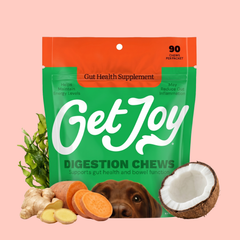
If your puppy is eating a food with biotics already built in, additional supplementation isn't necessary under normal circumstances. Supplementation becomes valuable during specific stress periods — transitioning to a new food, recovering from illness or antibiotics, moving to a new home, or any period of significant disruption. In those cases, a targeted supplement like Digestion Chews can provide additional support beyond what the everyday diet delivers.
Is freeze-dried raw food safe for puppies?
When it's complete, balanced, and formulated to AAFCO All Life Stages standards, yes. Get Joy Freeze-Dried Raw Meals meet these requirements and are appropriate for puppies at all life stages, including large-breed puppies. The freeze-drying process preserves the nutritional integrity of whole food ingredients while removing the moisture that supports bacterial growth, making it a safe and highly digestible format for developing digestive systems.
Start Strong. Feed for the Long Game.
Get Joy Freeze-Dried Raw Meals are built for all life stages — with Belly Biotics, real whole food, and the complete nutrition puppies need from day one.
Browse More Topics
Shop by Concern


Featured Posts
Keeping Your Dog Healthy in Winter: Cold Weather, Immunity, and Gut Health
The Best Dog-Safe Christmas Treats (Store-Bought and Homemade)