Bestseller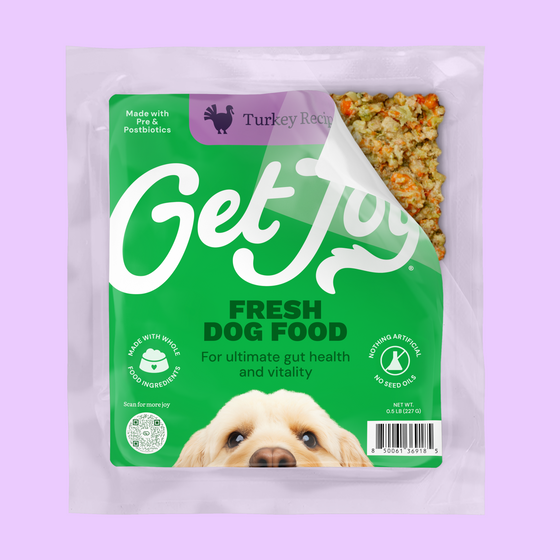
 Gut health
 Sensitive stomach
 Calm
Calm Joints & mobility
 Skin & coat
 Healthy weight
 Picky eaters



How Freeze-Drying Works — And Why Temperature Is Everything
by The Get Joy Food Team ・ 20 min readLast Updated: July 1, 2026
Freeze-drying removes moisture through a process called sublimation — converting ice directly into vapor without ever passing through a liquid phase. This means raw ingredients are preserved at low temperatures, retaining the nutritional profile, enzymes, and live probiotic cultures that heat-based processing destroys. The result is food that looks, smells, and nourishes like raw, but stores like kibble. Temperature control during processing is what separates genuine nutrition preservation from a fresh-food illusion.
🐾 Key Takeaways
- Freeze-drying uses sublimation — ice converts directly to vapor with no heat damage to nutrients or enzymes.
- Get Joy's process peaks at 125°F; many competitors process at 150–160°F, destroying heat-sensitive nutrients.
- The IQF (Individual Quick Freeze) tunnel flash-freezes ingredients rapidly, forming small ice crystals that protect cell structure.
- Get Joy retains 3 billion CFU of probiotics per pound — possible because no HPP, irradiation, or acidifiers are used.
- Freeze-dried meals achieve 95%+ gelatinization, meaning starches are more digestible and nutrients more bioavailable than most competitors.
Table of Contents
- What freeze-drying actually is
- The 6 steps of Get Joy's freeze-dry process
- Why the IQF tunnel matters
- The temperature difference — 125°F vs. 150–160°F
- Why probiotics survive our process (and die in others)
- Gelatinization — the nutrient absorption bonus
- Storage, shelf life, and serving
- Frequently Asked Questions
What Freeze-Drying Actually Is
Most people understand that freeze-drying involves cold and dryness. What's less understood is the physics that make it special: sublimation.
Normally, water goes through three states: solid (ice), liquid, then gas (vapor). In freeze-drying, we skip the liquid phase entirely. By pulling the air out of the environment (creating a vacuum) while the food is frozen solid, we allow ice crystals to convert directly into vapor. The food desiccates without ever becoming wet again. There is no heat-induced melting, no boiling, no steam damage.
Why does skipping the liquid phase matter? Because liquid water is what carries dissolved nutrients away from food during conventional drying. It's what causes texture degradation, color change, and enzyme denaturation. Sublimation preserves the cellular structure, flavor compounds, enzymatic activity, and nutritional density of the original raw ingredient.
This is why freeze-dried food doesn't look or smell like dehydrated food. Dehydrated food is dried with heat — often at 140–180°F — which changes color, flavor, and nutrition in the process. Freeze-dried food retains the color, aroma, and nutritional density of fresh because it was never cooked.
The 6 Steps of Get Joy's Freeze-Dry Process
Here's exactly how we go from fresh raw ingredients to the shelf-stable, nutrient-dense product in the bag:
Step 1: Mix and form. Raw ingredients are selected, weighed, and mixed according to recipe specifications. The product is then formed into its final shape — this is the only step that resembles conventional food manufacturing. From here, every decision is made to protect nutritional integrity, not to make processing easier.
Step 2: IQF tunnel. The formed product moves through an Individual Quick Freeze (IQF) tunnel. This flash-freezes the product at very low temperatures in a fraction of the time conventional freezing would take. We'll explain why this step matters in detail shortly.
Step 3: Load the chamber. The frozen product is arranged on sheet pans, loaded onto carts, and placed into the freeze-dry chamber. This step is about controlled organization — consistent loading ensures even drying throughout the cycle.
Step 4: Vacuum to −40°F. The chamber is sealed and a vacuum is applied. As pressure drops, the product temperature falls to approximately −40°F. At this temperature and pressure, the conditions for sublimation are set. The ice in the product is locked and ready to transition.
Step 5: Sublimation begins. Cooling stops, and a controlled, low level of heat is applied to the chamber. This is the primary drying phase. The applied heat provides just enough energy for ice molecules to convert directly to vapor — which is then drawn out of the chamber by the vacuum. No liquid forms. The food dries from the inside out, preserving structure at the cellular level. Our maximum product temperature during this phase: 125°F.
Step 6: Off-load and package. The cycle completes. The remaining bound water molecules are removed in a secondary drying phase, bringing moisture content to a level that ensures stability. The product is offloaded from the chamber and packaged in moisture-barrier bags to protect what the process just worked so hard to preserve.
Why the IQF Tunnel Matters
The IQF tunnel — Individual Quick Freeze — is one of the least-discussed but most important steps in our process. Here's the problem it solves:
When water in food freezes slowly, it forms large ice crystals. Large ice crystals expand and puncture cell walls. When the ice melts or sublimates, you're left with a product whose cellular structure has been compromised — nutrients leak out, texture degrades, and the food loses the structural integrity that makes it worth eating.
The IQF tunnel freezes the product so rapidly that only small ice crystals form. Small crystals fit between cells rather than puncturing through them. The cellular structure of the meat, organs, and other ingredients is preserved intact. When sublimation removes those small crystals as vapor, it leaves behind a product whose cells are still whole — and whose nutrients are still where they belong.
This is the difference between freeze-dried food that rehydrates cleanly — recovering its texture, color, and flavor — and freeze-dried food that rehydrates into a mushy, degraded version of itself. The IQF step is invisible to the consumer but fundamental to the outcome.
The Temperature Difference — 125°F vs. 150–160°F
This is where most consumers' eyes glaze over — and where the most meaningful differentiation in freeze-dried dog food actually lives.
During the sublimation phase, some amount of heat must be applied to provide the energy needed for ice-to-vapor conversion. The question is: how much? The answer determines whether the heat-sensitive nutrients, enzymes, and live probiotic cultures in the food survive the process.
Get Joy's process reaches a maximum product temperature of 125°F. Many competitors run their freeze-dry cycles at 150–160°F. That 25–35 degree gap sounds modest, but at the molecular level, it's the difference between preservation and degradation.
Here's why:
- Probiotic bacteria begin losing viability above approximately 120–130°F. At 150–160°F, significant die-off occurs during the drying cycle itself — before the product even reaches a shelf.
- Heat-sensitive enzymes that support digestion and nutrient absorption denature (lose their functional shape) at temperatures above 118–125°F. Higher processing temps destroy these before the dog ever eats the food.
- Omega-3 fatty acids oxidize more rapidly at higher temperatures, reducing their anti-inflammatory and cellular health benefits.
- Amino acid profiles can shift under sustained heat exposure, reducing the quality of the protein your dog absorbs.
| Component | At 125°F (Get Joy) | At 150–160°F (many competitors) |
|---|---|---|
| Live probiotic cultures | Largely retained | Significant die-off during drying |
| Heat-sensitive enzymes | Better preserved | More likely to denature |
| Omega-3 fatty acids | Slower oxidation | Faster oxidation |
| Protein / amino acid quality | More stable | Can shift under sustained heat |
Running the process at a lower temperature requires more time and more precise engineering. It's slower and more expensive. Competitors who run hotter are often optimizing for throughput, not for what ends up in your dog's bowl.
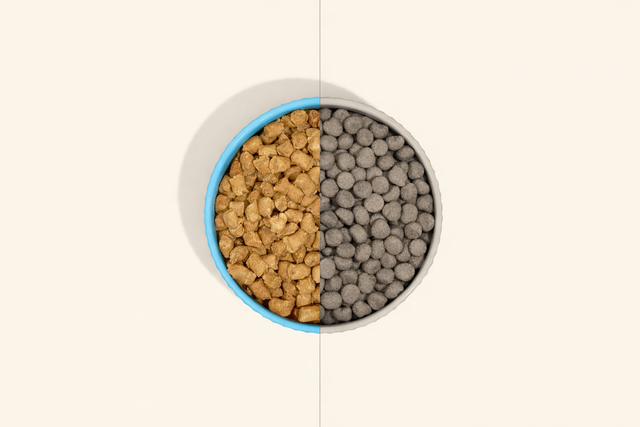
See the difference for yourself
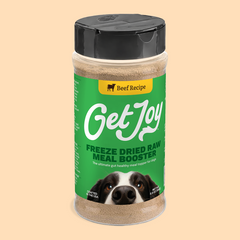
Get Joy's Freeze-Dried Raw Meals are processed at 125°F maximum, in an SQF-certified facility, with no HPP, irradiation, or acidifiers. The result is food that earns the word "raw."
Why Probiotics Survive Our Process (and Die in Others)
Most freeze-dried dog foods that claim to include probiotics add them as a post-process spray or coating — because the probiotic cultures couldn't survive the original processing. At Get Joy, Belly Biotics™ — our proprietary prebiotic, probiotic, and postbiotic blend — is built directly into the food from the start, and it survives because our process is designed to let it.
The three things that kill probiotics in food processing are:
- Heat: High processing temperatures above 130°F cause significant bacterial die-off. Our 125°F ceiling protects viability.
- HPP (High Pressure Processing): HPP uses extreme pressure to kill pathogens, but it also destroys probiotic bacteria. We don't use HPP. Instead, we rely on a competitive inhibition approach — a healthy, dense microbial community that naturally outcompetes harmful pathogens.
- Irradiation and acidifiers: Both are used by some manufacturers as kill steps, and both damage or destroy probiotic viability. Get Joy uses neither.
The result: our Freeze-Dried Raw Meals contain 3 billion CFU of live probiotic cultures per pound — a meaningful dose that delivers genuine gut health support, not just a label claim.
For more on why we made this choice, read our full explanation: Why We Don't Use HPP in Our Dog Food.
Gelatinization — The Nutrient Absorption Bonus
One of the less-discussed advantages of our freeze-dry process is what it does to starches. Gelatinization is the process by which starch granules absorb water and swell, breaking down their crystalline structure into a form that digestive enzymes can access. More gelatinized starch means more digestible carbohydrates and better nutrient absorption overall.
Get Joy's freeze-dried meals achieve 95%+ gelatinization compared to less than 80% in most competitors' products. What does that mean practically? Your dog extracts more nutritional value from every bite. The same quantity of food delivers more energy, more usable nutrients, and less digestive waste.
This matters especially for dogs with sensitive digestion, older dogs with reduced digestive efficiency, and any dog whose gut health is already compromised. Better gelatinization means the gut has less work to do and more to show for it.
Storage, Shelf Life, and Serving
One of freeze-drying's most practical benefits is shelf stability. Without moisture, microbial growth cannot occur — which is why properly sealed freeze-dried food doesn't need refrigeration and lasts far longer than fresh or raw-frozen formats.
Shelf life: Get Joy Freeze-Dried Raw Meals have a 2-year shelf life from the date of manufacture. This is possible because 95–98% of moisture has been removed and the packaging is sealed against moisture intrusion.
Storage: Store in a cool, dry place with the bag sealed between servings. Heat and humidity are the enemies of freeze-dried food — not because they cause spoilage overnight, but because they gradually re-introduce moisture, which shortens shelf life and can degrade the probiotics over time.
Serving: Freeze-dried meals rehydrate easily. Add water or bone broth, allow a few minutes to absorb, and serve. The food recovers its original texture and aroma because the cellular structure was preserved intact during processing — it's not reconstituting from a degraded state, it's simply replacing the water that was removed.
Transitioning: If your dog is moving from kibble or cooked food to freeze-dried raw, introduce it gradually over 7–10 days. Mixing with the current food and increasing the freeze-dried ratio each day allows the gut microbiome time to adjust to a significantly more nutrient-dense diet.
Frequently Asked Questions
How does freeze-drying work for dog food?
Freeze-drying removes moisture through sublimation — a process where frozen water converts directly from solid to vapor without passing through a liquid phase. This happens in a vacuum chamber at low temperatures, preserving the nutritional profile, enzymes, and live probiotic cultures that heat-based processing would destroy. The result is food that stores like kibble but nourishes like raw.
Is freeze-dried dog food the same as raw dog food?
Freeze-dried dog food starts as raw food and uses low-temperature processing to remove moisture without cooking. The nutritional profile is very similar to raw, but without the handling risks of frozen raw and with a much longer shelf life. The key variable is processing temperature: at 125°F, heat-sensitive nutrients and probiotics survive. At 150–160°F, many are damaged.
What is the IQF tunnel in freeze-dried dog food manufacturing?
IQF stands for Individual Quick Freeze. It's a flash-freezing tunnel that freezes ingredients at extremely low temperatures in a short time, forming small ice crystals rather than large ones. Small ice crystals don't puncture cell walls, so the cellular structure of the ingredients remains intact. This protects nutritional content and ensures the food rehydrates properly instead of becoming mushy.
Why does processing temperature matter for freeze-dried dog food?
Processing temperature determines whether heat-sensitive nutrients, enzymes, and probiotic bacteria survive. At 125°F (Get Joy's maximum), these compounds remain intact. At 150–160°F (common in the industry), probiotic die-off is significant, enzymes denature, and omega-3 fatty acids oxidize more rapidly. Lower temperature processing takes more time and precision but delivers a meaningfully more nutritious product.
How long does freeze-dried dog food last?
Get Joy Freeze-Dried Raw Meals have a 2-year shelf life from the date of manufacture when stored sealed in a cool, dry place. This is possible because 95–98% of moisture has been removed, leaving no water for microbial growth. Once opened, keep the bag sealed between servings and store away from heat and humidity to maintain probiotic viability and shelf stability.
Nutrition that works from the inside out
Get Joy Freeze-Dried Raw Meals are made in an SQF-certified facility at 125°F maximum — preserving what raw food is supposed to deliver. No HPP, no irradiation, no shortcuts. Just food your dog's gut was designed for.
Browse More Topics
Shop by Concern


Featured Posts
Keeping Your Dog Healthy in Winter: Cold Weather, Immunity, and Gut Health
The Best Dog-Safe Christmas Treats (Store-Bought and Homemade)