Bestseller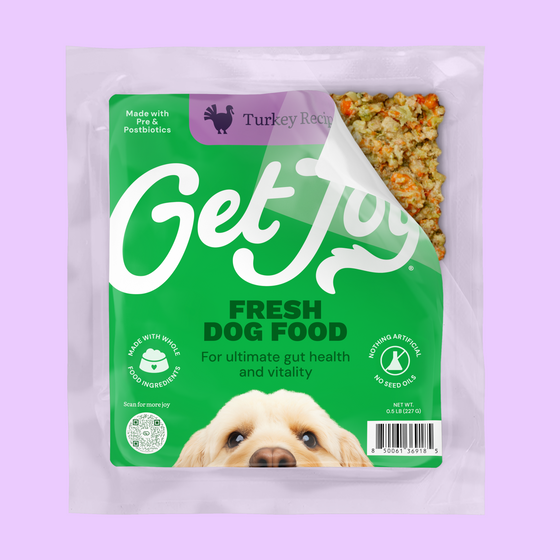
 Gut health
 Sensitive stomach
 Calm
Calm Joints & mobility
 Skin & coat
 Healthy weight
 Picky eaters



How to Read Dog Food Labels
by The Get Joy Team ・ 18 min readLast updated: May 2026
Key Takeaways
- AAFCO product naming rules tell you exactly how much of a named ingredient is actually in the food — and the differences are dramatic (95% vs 25% vs 3%).
- Ingredients are listed by weight before processing. Fresh chicken contains ~80% water; chicken meal contains ~10%. That "chicken first" label may be more marketing than substance.
- Ingredient splitting is a common trick — separating forms of the same ingredient (corn, corn gluten meal, corn bran) to make it appear lower on the list than it actually is.
- The nutritional adequacy statement is the most legally binding information on the package — it tells you whether the food is actually complete and balanced for your dog's life stage.
- Look for named protein sources, natural preservatives, specific fat sources, and functional ingredients like prebiotics and postbiotics as signals of quality.
- Processing method matters: high-heat extrusion destroys heat-sensitive vitamins and probiotics. Freeze drying preserves them.
Most Affected Breeds: All dog breeds and life stages benefit from understanding food labels. Every dog parent deserves to know what they're buying — and what the label actually means versus what marketing wants you to think it means.
Navigating dog food labels can feel overwhelming at first glance — rows of unfamiliar ingredients, percentages, and marketing buzzwords all competing for your attention. But once you know what to look for, reading these labels becomes one of the most powerful tools you have for protecting your dog's health and making confident choices at the store.
AAFCO: The Basics of Dog Food Labeling
The Association of American Feed Control Officials (AAFCO) is the unsung hero of dog food transparency. This organization doesn't manufacture food or enforce regulations directly, but it creates the standards that guide how dog food labels must present information — ensuring you're working with consistent, reliable information across brands.
AAFCO's product naming rules alone can save you from marketing tricks. If a food is called "Chicken Dog Food," chicken must make up at least 95% of the total weight (excluding water). Drop down to "Chicken Dinner" or "Chicken Formula," and chicken only needs to comprise 25% of the product. See "With Chicken"? That means just 3% chicken minimum. These aren't arbitrary numbers — they prevent brands from misleading dog companions about what's actually in the bag.
AAFCO also establishes nutritional profiles that determine whether a food can claim to be "complete and balanced." These profiles specify minimum and maximum levels for proteins, fats, vitamins, and minerals based on life stages like puppy, adult, or senior. Understanding these guidelines transforms you from someone who guesses at ingredient quality to someone who can spot healthy dog food with confidence.
Decoding Ingredient Lists: Weight Order, Splitting, and More
Understanding ingredient lists starts with one crucial fact: ingredients appear in descending order by weight before processing. The first ingredient makes up the largest portion by weight — which seems straightforward until you consider that fresh ingredients contain significantly more water than their processed counterparts. This changes everything about how you evaluate what's actually in the bowl.
Fresh vs. dried weight matters tremendously. Fresh chicken might top the list, but once that water cooks off, it could rank much lower than the chicken meal listed fourth. Fresh chicken contains about 80% water; chicken meal contains only about 10% water. That "chicken first" label may be more about marketing than actual protein content.
Ingredient splitting artificially inflates protein sources. Brands separate related ingredients (chicken, chicken meal, chicken fat) to make meat appear more prominent, while corn, wheat, or rice might actually dominate when combined. If you see "ground corn, corn gluten meal, corn bran" scattered throughout the ingredients, corn is likely a major component despite not appearing first.
Watch for heavy plant ingredients clustering at the top. Multiple grain or starch sources early in the list often signal a carb-heavy formula disguised as protein-forward.
Generic terms hide quality. "Meat meal" or "poultry by-product" don't tell you much about source quality. Specific named sources (chicken meal, salmon meal) indicate better ingredient transparency. Brands that prioritize transparency in ingredient sourcing and processing make this evaluation easy — they're upfront about their choices.
Understanding the Guaranteed Analysis: What the Numbers Tell You
The guaranteed analysis is your nutritional cheat sheet — four simple percentages that reveal more about a food's quality than flashy marketing claims ever could. This required section shows the minimum protein and fat content, plus maximum fiber and moisture levels.
Crude Protein (minimum): Look for at least 18% for adult dogs, 22% for puppies. Higher isn't always better — active working dogs might thrive on 25–30%, while senior dogs with kidney concerns may need less. The source and bioavailability of that protein matters as much as the percentage.
Crude Fat (minimum): Typically ranges from 8–22%. Active dogs need higher fat for energy, while less active or overweight dogs benefit from the lower end of this range.
Crude Fiber (maximum): Usually 2–5%. Higher fiber helps with weight management and digestion, but too much interferes with nutrient absorption. Note that "crude fiber" represents minimum insoluble fiber, not total functional fiber.
Moisture (maximum): Dry foods contain 6–10% moisture, while wet foods can reach 78%. This dramatically affects the other percentages. Pro Tip: Comparing wet and dry foods? Convert to "dry matter basis" by removing moisture from the equation. A wet food with 8% protein and 75% moisture actually contains about 32% protein on a dry matter basis.
Nutritional Adequacy Statements: Ensuring Complete and Balanced Meals
The nutritional adequacy statement is hands down the most legally binding piece of information on any dog food package. It tells you whether the food has been formulated to meet your dog's complete nutritional needs according to AAFCO standards — separating real complete food from supplemental products.
What to look for: AAFCO compliance language ("formulated to meet" or "complete and balanced for" followed by specific AAFCO nutrient profiles); life stage specification (the statement must clearly indicate whether the food is appropriate for puppies, adults, seniors, or all life stages); testing method verification (foods tested through AAFCO feeding trials offer more reliable nutritional proof than those meeting requirements through formulation alone).
What to look for: "This food is formulated to meet the nutritional levels established by the AAFCO Dog Food Nutrient Profiles for [specific life stage]."
Red flags: Vague language like "provides complete nutrition" without AAFCO reference; missing life stage information; or statements that only claim "supplemental" or "intermittent" feeding purposes — these foods should not be used as your dog's primary diet.
This foundation matters because nutrition is the foundation of your dog's long-term health and vitality. A properly crafted adequacy statement guarantees that every bowl delivers the nutritional building blocks your dog needs to thrive.
Reading Labels Like a Pro: Step-by-Step
Reading dog food labels becomes second nature once you develop a systematic approach. Here's the exact method to use on your next store run:
Step 1: Examine the first five ingredients closely. These make up the bulk of the food by weight. Look for named meat sources like chicken, beef, or salmon — not "poultry" or "meat." A protein-forward recipe should show whole-food ingredients in recognizable form.
Step 2: Identify ingredient splitting. If you see "ground corn, corn gluten meal, corn bran" scattered through the list, add them up — corn is likely a major component despite not appearing first. This is a common way to move grains or starches down the list while they collectively dominate the formula.
Step 3: Decode meat meals and by-products. "Chicken meal" is actually concentrated protein with moisture removed — more protein-dense than fresh chicken. But avoid generic "meat meal" or "by-product meal" since you can't verify the source or quality.
Step 4: Spot preservatives and additives. Natural preservatives like mixed tocopherols (vitamin E) are preferable to chemical options like BHA, BHT, or ethoxyquin. Artificial colors serve zero nutritional purpose and often signal lower-quality food.
Step 5: Check for unnecessary fillers. Corn syrup, excessive grains, or multiple sugar sources add empty calories without benefits. Quality foods stick to whole ingredients you'd recognize.
Step 6: Scan for beneficial additions. Probiotics, prebiotics, postbiotics, omega fatty acids, and chelated minerals show a manufacturer thinking beyond basic nutritional minimums. These additions — particularly gut health support like Belly Biotics™ — indicate a food designed for actual outcomes, not just AAFCO compliance.
Ingredients to Evaluate Carefully
Certain ingredients deserve extra attention — not because they're inherently harmful, but because they can signal lower nutritional value or potential digestive issues for some dogs.
Meat meals and by-products require scrutiny. While "chicken meal" can be protein-dense (water is removed), vague terms like "meat meal" or "poultry by-product meal" don't tell you much about quality or source. Look for specific, named sources instead.
Artificial preservatives like BHA, BHT, and ethoxyquin are worth avoiding. Natural alternatives like mixed tocopherols (vitamin E) work just as well without the health concerns associated with synthetic preservatives.
Generic fats and oils like "animal fat" or "vegetable oil" are red flags. Quality foods specify their fat sources — chicken fat, salmon oil, coconut oil — so you know exactly what your dog is eating and in what ratio.
Excessive fillers like corn gluten meal, wheat middlings, or rice hulls add bulk without meaningful nutrition. They're not harmful at low levels, but they often signal that protein and nutrients are coming from cheaper sources rather than whole ingredients.
Processing method matters significantly. Traditional kibble uses high-heat extrusion, which destroys beneficial enzymes, heat-sensitive vitamins, and live probiotics. Freeze Dried Raw processing removes moisture while maintaining the nutritional integrity of raw ingredients — including nutrients that a standard kibble manufacturing process would destroy before your dog ever gets to eat it.
Artificial colors and flavors serve zero nutritional purpose. They're designed to appeal to humans. If a food needs artificial flavor enhancement, question what's missing from the base ingredients.
A Label You Can Actually Trust
Get Joy's Freeze Dried Raw Meals check every box — named USDA proteins, whole-food ingredients, AAFCO complete and balanced, no artificial additives, and Belly Biotics™ prebiotics, probiotics, and postbiotics built into every bag. When you know what to look for, Get Joy is the easy choice.
Shop Freeze Dried Raw Meals See Our IngredientsRelated Reading
When You Know What to Look For, Get Joy Is the Easy Choice.
Named proteins. Whole-food ingredients. AAFCO complete and balanced. Belly Biotics™ built in. No artificial anything.
Shop Freeze Dried Raw Meals See Our IngredientsFrequently Asked Questions
What does "complete and balanced" mean on dog food labels?
"Complete and balanced" means the food meets the minimum nutritional requirements established by AAFCO for a specific life stage. It must be either formulated to meet AAFCO nutrient profiles or proven through feeding trials. Any food making this claim must specify the life stage it's appropriate for — "all life stages" is the most inclusive claim and must meet the most demanding nutritional requirements.
Is the first ingredient on a dog food label the most important?
It's the most prevalent by weight before processing — but it's not the only thing that matters. Because of moisture content differences, a "chicken first" label on a dry food may indicate less actual chicken than it appears once cooked. Look at the first 5 ingredients as a whole, and watch for ingredient splitting that artificially positions plant-based fillers lower on the list.
What does "crude protein" mean and how much does my dog need?
Crude protein refers to the estimated total protein content, measured by nitrogen content rather than direct protein measurement. It's a minimum guarantee. Adult dogs typically need at least 18% crude protein, puppies at least 22%, though quality and bioavailability matter more than the raw percentage. A 30% crude protein from a high-quality named meat source is meaningfully different from 30% crude protein from a lower-quality mixed source.
Are meat by-products bad for dogs?
Not necessarily. Named meat by-products — like "chicken liver" or "beef heart" — are actually nutrient-dense organ meats that often exceed muscle meat in vitamin and mineral content. Generic "meat by-products" or "poultry by-products" without species specification are more concerning, as you can't verify the source or quality. The word "by-product" itself isn't the problem — specificity is what matters.
What are the red flags on a dog food label?
Key red flags include: "meat meal" or "poultry by-product" without a named species; BHA, BHT, or ethoxyquin as preservatives; artificial colors (Red 40, Yellow 5, etc.); multiple sugar or corn syrup entries; "animal fat" without a named species; and vague terms like "natural flavors" without specification. A label with many recognizable whole-food ingredients, named protein sources, and natural preservatives is a positive signal.
Does processing method affect what I see on the label?
Yes, but not directly in the ingredient list — processing method affects how much of those listed nutrients actually survive to benefit your dog. High-heat extrusion destroys heat-sensitive vitamins and kills live probiotics before your dog ever eats them. Freeze drying preserves them. When evaluating two foods with similar labels, the processing method tells you how much of what's listed actually makes it to your dog's gut in usable form.
Browse More Topics

Written by
The Get Joy Team
Shop by Concern


Featured Posts
Keeping Your Dog Healthy in Winter: Cold Weather, Immunity, and Gut Health
The Best Dog-Safe Christmas Treats (Store-Bought and Homemade)