Bestseller
 Gut health
 Sensitive stomach
 Calm
Calm Joints & mobility
 Skin & coat
 Healthy weight
 Picky eaters



The Month We Took Our Dog Off Kibble
by The Get Joy Food Team ・ 19 min readLast updated: May 2026
Key Takeaways
- Switching Luna off kibble for 30 days produced visible changes in her coat, energy, digestion, and mood — week by week.
- Research shows an 81% decrease in disease markers in dogs switched from kibble to fresh food in just three months.
- Dogs switched back to kibble saw a 353% spike in those same disease markers — a reversal that happens fast.
- 83% of pet parents believe gut health can extend a dog's longevity. The science is starting to back them up.
- Get Joy's Freeze Dried Raw Meals include Belly Biotics™ — a built-in blend of prebiotics, probiotics, and postbiotics — so gut support isn't an afterthought. It's the foundation.
If you've ever stood in the pet food aisle, bag of kibble in one hand and your phone in the other, doom-scrolling ingredient lists you can barely pronounce — this story is for you.
I'd been feeding Luna the same kibble for three years. It was a "good" brand. Vet-approved. Appropriately expensive. She ate it without complaint, her bowl licked clean every morning. I told myself that was enough.
But somewhere in the back of my mind, a question kept surfacing: is she just eating it because she's hungry, or is she actually thriving?
Luna is a four-year-old mixed breed with the energy of a toddler on a sugar high and the emotional range of a golden retriever. She's dramatic, devoted, and completely ridiculous. She is also, I realized, not quite as bright-eyed as she used to be. Her coat had lost some of its shine. She begged constantly — not playful nudging, but frantic, insistent begging that never really stopped. Her digestion was, let's say, unpredictable.
I started wondering if the food had anything to do with it.
So we ran an experiment. For 30 days, Luna came off kibble entirely. Here's what happened — week by week — and the research that explains why the results weren't actually a surprise.
Week 1: Breaking Old Habits
The first morning, Luna walked up to her bowl, sniffed it, and looked at me like I'd served her something offensive. She circled it twice, sniffed again, and sat down next to it, waiting. She was suspicious of the food that was actually good for her. Classic dog.
By day two, the hesitation was gone. She inhaled her meal in about thirty seconds and then stood at the bowl wagging her tail — which she had never done with kibble. Not once in three years. I took note.
While she adjusted, I did some reading. I flipped over her old bag of kibble and started going through the ingredient list. The first several ingredients were familiar enough, but the further down I got, the more the list started to read like a chemistry exam. Preservatives I didn't recognize. "Natural flavors" listed without any indication of what they actually were. Fillers that showed up under different names but amounted to the same thing: bulk with minimal nutritional purpose.
I wasn't horrified — that kibble had kept her alive and generally healthy. But "alive and generally healthy" started to feel like a pretty low bar when I thought about what food could actually do for her body. The difference between surviving and thriving is real, and most of us don't interrogate it until something prompts us to look.
By the end of week one, Luna was eating well and seemed calm. No dramatic transformation yet. But the tail wags at mealtime had become a twice-daily ritual, and that felt like something worth paying attention to.
Week 2: The Energy Shift
This was the week things started to feel different in ways I hadn't anticipated.
The begging stopped. Or rather — it changed. Luna had always been an obsessive food-seeker. Hovering while I cooked. Planting herself under the table during dinner. Staring at me with the laser focus of someone who had not eaten in three weeks. By week two, that manic edge was gone. She was calm between meals. Interested in other things. She'd get up to look out the window, chew a toy, take a nap — without checking back in with the kitchen every ten minutes.
That shift surprised me more than I expected. I'd always assumed the begging was just personality. Turns out, it might have been diet.
Here's why: highly processed diets can alter hunger signals in dogs, in part by driving low-grade inflammation that disrupts the hormones and gut signals that regulate satiety. When the gut is inflamed and its microbial balance is off, the body doesn't read fullness the way it should. Luna wasn't begging because she was greedy. She may have been begging because she was genuinely never satisfied — not at a caloric level, but at a biological one.
She was also more playful in a way that felt different from her usual bouncy energy. Less frantic. More present. We had a long play session in the backyard on day eleven that was one of the better ones we'd had in months — focused, joyful, the kind where she actually makes eye contact and holds it.
Small things. But they were adding up.
Week 3: Visible Changes
By week three, I could see the difference.
Luna's coat, which had been fine but slightly dull, had taken on a softness and sheen that made me do a double-take. I'd run my hand along her back in the morning the way I always do and noticed it immediately — the texture was different. Smoother. More alive somehow. My partner noticed it too without me saying anything first.
Her digestion had also regulated in a way I hadn't fully appreciated until it happened. I'll spare you the full details, but suffice it to say: things were more consistent, less urgent, and far less odorous. If you have a dog, you understand what a meaningful quality-of-life improvement this is — for everyone in the household.
She also looked trimmer. Not thinner — she wasn't losing weight we needed to worry about — but the slight bloat around her midsection had eased, and her waist had definition again. The kind of thing that's easy to miss slowly appearing and equally easy to miss when it quietly disappears.
I looked into the research. What I found was striking.
A study examining dogs switched from kibble to fresh food found an 81% decrease in disease markers over just three months. Eighty-one percent. The same study found that dogs switched back to kibble experienced a 353% spike in those same disease markers. The reversal wasn't gradual — it was swift and significant, a biological rebound that underscores how responsive the body is to what it's being fed.
Three weeks in, I was no longer surprised by what I was seeing in Luna. I was surprised it had taken me this long to look.
Gut Health, Built Into Every Meal
Get Joy's Freeze Dried Raw Meals include Belly Biotics™ — prebiotics, probiotics, and postbiotics — as a structural ingredient in every bowl. Not a sprinkle. The foundation your dog deserves.
Shop Freeze Dried Raw MealsWeek 4: A New Dog
I'll be honest: I went into this expecting to notice a few things, feel good about the experiment, and then write it off as an interesting month. I did not expect to be genuinely moved by what thirty days of better food did for my dog.
By week four, Luna was going on longer walks — not because I was pushing her, but because she was pulling me. She had a stamina and eagerness on our evening routes that I hadn't seen in a while, stopping to investigate things with curiosity instead of shuffling along like a creature doing her civic duty. On more than one occasion she launched into full zoomies in the backyard at six in the morning for no reason other than the apparent joy of it.
She also seemed calmer in her downtime. Easier to settle. Less reactive to sounds and movement. Whether that's connected to gut health or coincidence, I can't say definitively — but I've since learned that the gut-brain axis in dogs is real, and that gut health has documented effects on anxiety and emotional regulation. It's not a stretch to imagine that a more balanced gut produces a more balanced dog.
The survey data bears this out at scale. 83% of pet parents believe gut health can extend their dog's longevity. 89% believe it improves daily quality of life. 77% believe it supports brain health. These aren't fringe beliefs — they're widespread intuitions that are increasingly backed by the science of the microbiome.
As veterinarian Dr. Renee Alsarraf, DVM, puts it: "Lifestyle and prevention are the key factors to good health, longevity, and happiness." Food is the most fundamental lifestyle factor there is. It's the one thing a dog's body interacts with multiple times every single day.
I looked at Luna at the end of week four — sprawled on her back on the couch, paws in the air, looking profoundly content — and felt something shift in me too. Feeding her well wasn't complicated. It didn't require a veterinary degree or hours of research. It required asking a better question than "will she eat it?" The better question is: what will it do for her?
What Made the Difference
I want to be specific here, because "better food" is a vague claim that doesn't help anyone.
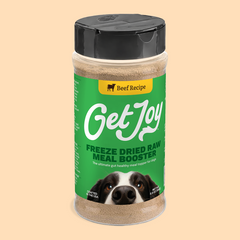
What we switched to was Get Joy's Freeze Dried Raw Meals. The ingredients are real and recognizable — whole proteins, vegetables, the kind of thing you could identify without a chemistry degree. But the part that I think explains a lot of what we saw in Luna is what Get Joy calls Belly Biotics™.
Belly Biotics™ is Get Joy's proprietary blend of prebiotics, probiotics, and postbiotics — and the thing that matters most is how it's delivered. It's not a topper. It's not a separate supplement you add to the bowl and hope stays mixed in. It's built directly into every meal as a structural ingredient. That means Luna gets consistent, full-dose gut support at every single feeding, automatically.
The gut microbiome isn't a side concern in dog health — it's the engine. A healthy gut supports digestion, immune function, nutrient absorption, skin and coat health, inflammation levels, and yes, the gut-brain connection that affects mood and behavior. When the microbiome is off, you tend to see it everywhere: in the coat, in digestion, in energy, in temperament. When it's supported, the whole system runs better.
That's what Get Joy means by gut-first nutrition. Not a gimmick, not a buzzword — a genuine belief that the gut is where whole-body health starts, and that building nutrition around that principle produces dogs that feel genuinely better, not just adequately fed.
If you're curious about the science behind gut health specifically, Get Joy's Gut Health 101 guide is a good place to start. It's readable, practical, and doesn't require a biology background.
Ready to See What 30 Days Can Do?
Luna's story isn't special. It's what happens when you feed a dog the way their body is actually built to be fed — real food, real ingredients, with Belly Biotics™ gut support built in from the start. Try Get Joy's Fresh Meals or Freeze Dried Raw and give your dog the same shot.
Shop Fresh Meals Shop Freeze Dried RawYour Questions, Answered
How long does it take to see results when switching a dog off kibble?
It varies by dog, but most pet parents start noticing changes in digestion and energy within the first two weeks. Coat improvements and body composition changes often become visible around weeks three and four. The research on disease markers shows meaningful changes over a three-month window, so the longer you stay consistent, the more the benefits compound.
Is it safe to switch dogs cold turkey, or does it need to be gradual?
A gradual transition is generally gentler on the digestive system — especially for dogs with sensitive stomachs. A common approach is to mix the new food in with the old over seven to ten days, increasing the ratio of new food each day. That said, some dogs handle a more direct switch without issue. Watch for any digestive upset and adjust the pace accordingly.
What are Belly Biotics™, and why do they matter?
Belly Biotics™ is Get Joy's proprietary blend of prebiotics, probiotics, and postbiotics — three categories of gut-support ingredients that work together to feed beneficial bacteria, introduce live beneficial strains, and deliver the byproducts that a healthy microbiome produces. What makes Belly Biotics™ different is that it's built into the meal itself, not added on top, which means your dog gets consistent gut support at every feeding without any extra steps on your end.
Can diet really affect a dog's behavior and mood?
Increasingly, yes — this is one of the more exciting areas of veterinary research. The gut-brain axis describes the two-way communication system between the gut and the brain. In dogs, as in humans, the health of the gut microbiome has documented effects on anxiety, stress responses, and emotional regulation. Dogs fed diets that support gut health often show reductions in anxious or reactive behavior. It's not a guarantee, but it's not coincidence either.
Is fresh or freeze dried raw food affordable enough to sustain long-term?
This is the question that stops a lot of people, and it's fair. Get Joy's Freeze Dried Raw Meals are designed to be a realistic option for everyday feeding, not just an occasional upgrade. The freeze-drying process preserves the nutritional integrity of raw food without the cost or complexity of refrigerated delivery — and because the food is more nutrient-dense, many dogs need less of it per meal than they would with kibble. It's worth running the numbers for your dog's size. For many families, the gap is smaller than expected.
Browse More Topics
Shop by Concern


Featured Posts
Keeping Your Dog Healthy in Winter: Cold Weather, Immunity, and Gut Health
The Best Dog-Safe Christmas Treats (Store-Bought and Homemade)