Bestseller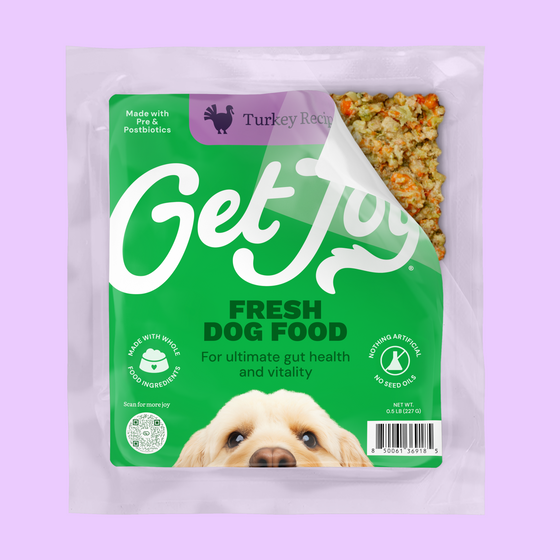
 Gut health
 Sensitive stomach
 Calm
Calm Joints & mobility
 Skin & coat
 Healthy weight
 Picky eaters



Kettle-Cooked vs. Sous-Vide Dog Food: Why the Method Matters
by The Get Joy Food Team ・ 19 min readLast Updated: July 1, 2026
Kettle-cooked means each ingredient is cooked separately to its optimal temperature, then combined. Sous-vide style means everything goes into a sealed bag and cooks together at one temperature. That difference — which sounds small on paper — has real consequences for nutrient retention, texture, and digestibility in your dog's food. Most gently cooked brands use the bag method. Get Joy doesn't.
🐾 Key Takeaways
- Kettle cooking processes each ingredient at its own optimal temperature — protecting heat-sensitive nutrients that get degraded when everything cooks together at the same temperature.
- Sous-vide style cooking (sealed bag, single temperature) produces a mushier, paste-like texture because all ingredients are exposed to the same heat regardless of their different ideal cooking points.
- Get Joy Gently Cooked meals are made in a USDA-certified kitchen using the kettle method — each protein and vegetable cooked separately, then combined.
- Every Get Joy Gently Cooked recipe includes built-in pre- and postbiotics (Belly Biotics), making it one of the only fresh cooked dog foods with gut health biotics built directly into the formula.
- Gently cooked offers the palatability and digestibility of fresh food with pathogen safety that raw formats require additional steps (HPP or irradiation) to achieve.
Table of Contents
- What "gently cooked" actually means in dog food
- The sous-vide problem — why one-temp cooking falls short
- Kettle cooking — how Get Joy does it differently
- Kettle-cooked vs. sous-vide at a glance
- Ingredient by ingredient — why optimal temperatures matter
- The biotic advantage — what makes Get Joy different
- Gently cooked vs. freeze-dried — how to choose
- Frequently Asked Questions
What "Gently Cooked" Actually Means in Dog Food
"Gently cooked" has become a popular category label in premium dog food, but the term isn't regulated. It doesn't specify a cooking temperature, a method, a duration, or a nutrient retention standard. Two brands can both call their food "gently cooked" and be doing something very different in the kitchen.
The concept behind gently cooked is sound: use lower cooking temperatures than traditional kibble processing (which often involves temperatures exceeding 280°F under high pressure) to preserve more of the natural nutrients, moisture, and palatability of whole food ingredients. Compare that to the extrusion process used to make kibble — where starches are forced through a die at extreme temperatures and pressure — and the case for lower-heat cooking is clear.
But "lower than kibble" still leaves a wide range of how gently cooked food actually gets made. The two main approaches are kettle cooking and sous-vide style cooking — and they produce meaningfully different results.
The Sous-Vide Problem — Why One-Temp Cooking Falls Short
Sous-vide cooking originated in professional kitchens as a precision technique: vacuum-seal food and cook it in a water bath at a tightly controlled temperature. In fine dining, this produces beautifully uniform results for a single protein cooked at its ideal temperature.
The problem in dog food manufacturing is that the technique is applied differently: multiple ingredients — proteins, vegetables, organ meats, carbohydrates — are combined and cooked together in a sealed bag at a single temperature. This approach ignores a fundamental reality of cooking: different foods have different optimal temperatures.
Chicken breast reaches peak safety and texture at around 165°F. Broccoli preserves its glucosinolates and vitamin C best at lower heat. Liver — a nutrient-dense organ meat — is optimally cooked at a different point than muscle meat. Carrots retain more beta-carotene when cooked briefly than when slow-cooked at length.
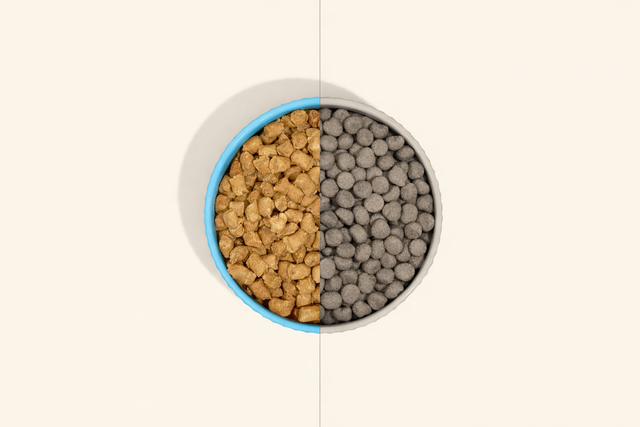
When everything cooks together in a bag at one temperature, some ingredients inevitably hit that temperature point correctly while others overcook or undercook. The result at the texture level is familiar to anyone who's opened a fresh dog food pouch: a mushy, paste-like consistency where individual ingredients have lost their distinct texture and structure. That mushiness isn't just aesthetic — it's a signal that the cooking process didn't respect the individual properties of each ingredient.
The nutrient implications are real. Heat-sensitive vitamins (particularly B vitamins and vitamin C) degrade faster at higher temperatures and longer exposure times. Enzymes in organ meats are more fragile than the structural proteins in muscle meat. A cooking method that applies the same temperature to all ingredients simultaneously cannot protect the most temperature-sensitive components while properly cooking the less sensitive ones.
Kettle Cooking — How Get Joy Does It Differently
Get Joy Gently Cooked meals are made in a USDA-certified kitchen using a kettle-cooking approach: each ingredient is cooked separately to its own optimal temperature, then the finished components are combined into the final recipe.
This is a more labor-intensive process. It requires separate preparation steps for proteins, organ meats, vegetables, and carbohydrates. It means more equipment, more time, and more precision in the kitchen. But it's the approach that actually honors the premise of gently cooked nutrition — treating each ingredient as something worth protecting, not just something to heat until it's safe.
The finished product reflects the difference. Get Joy Gently Cooked meals have distinct ingredient texture — you can see the vegetables, identify the meat, recognize what's in the bowl. The food looks like food, because each component was cooked the way that component should be cooked.
After cooking and combining, the meals are frozen for a 16-month shelf life. Once thawed and refrigerated, they keep for four days — the standard for fresh food. The frozen format preserves the nutritional integrity achieved in the kettle cooking process without requiring preservatives or additional processing.

Kettle-Cooked vs. Sous-Vide at a Glance
| Factor | Kettle-Cooked (Get Joy) | Sous-Vide Style (bag) |
|---|---|---|
| How ingredients cook | Each cooked separately to its own optimal temperature | All cooked together at one temperature |
| Heat-sensitive nutrients | Better protected by targeted cooking | More prone to degrading at a shared temperature |
| Texture | Distinct, recognizable ingredients | Often mushy, paste-like |
| Gut support | Belly Biotics built into every recipe | Biotics typically not included |
Ingredient by Ingredient — Why Optimal Temperatures Matter
To understand why separate cooking matters, it helps to think about what actually happens to individual ingredients at different temperatures.
Poultry and beef muscle meat need to reach minimum internal temperatures for pathogen safety (165°F for poultry, 160°F for ground beef). Cooking to these targets while avoiding extended over-exposure produces meat that's safe, digestible, and retains its amino acid profile. Over-cooked muscle meat becomes drier, tougher, and less palatable — and Maillard reaction products (the browned compounds from high heat) can reduce the bioavailability of lysine, a critical amino acid.
Organ meats (liver, heart, kidney) are nutritional powerhouses — rich in vitamins A, B12, copper, zinc, and CoQ10 — but they're more delicate than muscle meat. They're higher in moisture and cook faster. Exposing them to prolonged high heat degrades more of their heat-sensitive B vitamins than a quick, targeted cook to safety temperature would.
Cruciferous vegetables (broccoli, cauliflower) contain glucosinolates — compounds with antioxidant and anti-inflammatory properties. These are significantly degraded by high heat and extended cooking. Brief exposure to lower temperatures preserves far more of these bioactive compounds than long cooking at higher heat.
Root vegetables (carrots) benefit from some cooking to increase the bioavailability of beta-carotene (a precursor to vitamin A) — but like all vegetables, extended high-heat cooking degrades their water-soluble vitamins. The sweet spot is cooking enough to improve digestibility without cooking so long that nutrient loss becomes significant.
Leafy greens (spinach) are particularly heat-sensitive. Their water-soluble vitamins — folate, vitamin C, vitamin K — degrade quickly at higher temperatures. Short, targeted cooking preserves more of what makes them nutritionally valuable.
A single-temperature cooking method cannot optimize for all of these simultaneously. Kettle cooking — ingredient by ingredient — is the only approach that can.
Gently Cooked the Right Way.
Get Joy Gently Cooked meals are kettle-cooked in a USDA-certified kitchen — every ingredient cooked separately to its optimal temperature, then combined. Four proteins. Biotics built in.
The Biotic Advantage — What Makes Get Joy Different From Other Fresh Food Brands
The cooking method is the most visible differentiator — but it's not the only one. Every Get Joy Gently Cooked recipe also includes Belly Biotics: a built-in blend of prebiotics and postbiotics that supports gut health from within the food itself.
This is genuinely unusual in the fresh and gently cooked dog food space. Most fresh food brands — even the good ones — don't include biotics in their formulas. The gut health conversation in pet food has largely been relegated to the supplement aisle. Get Joy's position is that gut health starts with the meal, not after the meal.
Inulin (prebiotic) is included in every Gently Cooked recipe. As a fiber that reaches the large intestine intact, it feeds the beneficial bacteria in your dog's gut directly — every meal, every day, without a separate powder or capsule.
Yeast Culture (postbiotic) delivers finished microbial metabolites — the bioactive compounds that beneficial gut bacteria produce — directly into the food. Rather than waiting for the gut to produce these compounds, postbiotics supply them immediately, supporting gut barrier function and reducing intestinal inflammation.
Every recipe is also formulated with salmon oil (omega-3 DHA and EPA), flaxseed, turmeric, and chelated mineral proteinates — the kind of functional ingredient list that shows up in supplements, built into the everyday meal. For the complete breakdown of what turmeric adds, see our article on why turmeric is in every Get Joy Gently Cooked recipe.
Expert formulation matters here too. Get Joy recipes are developed by a Ph.D. Animal Nutritionist and a Veterinarian working in combination — which is how you end up with a food that meets AAFCO All Life Stages (including large-breed puppies) while also being genuinely functional at a gut health level.
Gently Cooked vs. Freeze-Dried — How to Choose
Get Joy offers two complete and balanced formats: Gently Cooked Frozen and Freeze-Dried Raw Meals. Both are gut-first, both include Belly Biotics, and both meet AAFCO All Life Stages. The choice between them comes down to practical factors more than nutritional ones.
Choose Gently Cooked if:
- Your dog is a picky eater who responds well to warm, moist food
- You prefer a familiar cooked-food format
- Your dog has a sensitive stomach that does better with cooked rather than raw-state proteins
- You want freezer storage with a 16-month shelf life
Choose Freeze-Dried Raw if:
- You want pantry-stable convenience without refrigeration until opened
- You're traveling or need portability
- You prefer the raw food nutritional philosophy with the safety and convenience of freeze-drying
- You want a format that's easy to mix with toppers or rotate with other meals
Many Get Joy customers use both — Gently Cooked as the primary meal and Freeze-Dried Raw for travel, toppers, or variety. Because both meet the same nutritional standard and both include Belly Biotics, there's no gut health tradeoff in switching between formats. For a deeper look at how freeze-drying works, see our piece on how the freeze-drying process preserves nutrition.
Frequently Asked Questions
What is the difference between kettle-cooked and sous-vide dog food?
Kettle-cooked means each ingredient is cooked separately to its own optimal temperature before being combined. Sous-vide style means all ingredients are sealed in a bag and cooked together at a single temperature. The difference matters for nutrient retention — temperature-sensitive ingredients like organ meats and leafy vegetables are better protected when cooked at their own optimal point rather than at the same temperature as everything else.
Why does some gently cooked dog food look mushy?
Mushiness is typically the result of sous-vide style cooking, where all ingredients are cooked together in a bag at the same temperature. Different ingredients have different optimal cooking temperatures and textures — when everything cooks together, some ingredients inevitably overcook. Kettle-cooked food, where each ingredient is cooked separately, maintains better individual ingredient texture and structure.
Is gently cooked dog food better than raw?
"Better" depends on your dog's individual needs and your priorities. Gently cooked food offers pathogen safety without HPP or irradiation, higher palatability for many picky eaters, and easier digestibility for some dogs. Raw food advocates point to enzyme preservation and the argument that cooking degrades some nutrients. The honest answer is that both can be excellent — quality of ingredients, completeness of formulation, and consistency of feeding matter more than format.
Does cooking dog food destroy nutrients?
Some nutrients are heat-sensitive and do degrade at higher temperatures — particularly vitamin C, some B vitamins, and certain enzymes. This is why cooking method matters. Lower-temperature, shorter-duration cooking (like kettle cooking to each ingredient's optimal temperature) preserves more of these nutrients than high-heat, extended processing like kibble extrusion. A quality gently cooked formula also adds back any nutrients lost in cooking through careful formulation.
What proteins does Get Joy Gently Cooked come in?
Get Joy Gently Cooked is available in four protein recipes: Chicken, Beef, Turkey, and Lamb. Each recipe uses the primary protein plus the corresponding organ meat (liver), combined with vegetables, functional carbohydrates, and a full suite of functional ingredients including salmon oil, flaxseed, turmeric, inulin (prebiotic), and yeast culture (postbiotic). All four recipes meet AAFCO All Life Stages standards.
Cooked Right. Formulated Smart.
Four proteins. Kettle-cooked in a USDA kitchen. Biotics built in. No paste. No bag cooking. Just real food, done right.
Browse More Topics
Shop by Concern


Featured Posts
Keeping Your Dog Healthy in Winter: Cold Weather, Immunity, and Gut Health
The Best Dog-Safe Christmas Treats (Store-Bought and Homemade)