Bestseller
 Gut health
 Sensitive stomach
 Calm
 Joints & mobility
 Skin & coat
 Healthy weight
 Picky eaters




What to Avoid in Freeze-Dried Dog Food Ingredients
by The Get Joy Food Team ・ 14 min readPublished October 2026 · Last reviewed October 2026
Not all freeze-dried dog foods are created equal. While the freeze-drying process itself is excellent at preserving nutrients, some brands still include ingredients you'd rather not put in your dog's bowl — from artificial preservatives to vague "meat by-products." Knowing what to look for on a label helps you choose a food that truly supports your dog's health from the inside out. Get Joy uses only whole, named ingredients with no artificial anything — and every meal includes Belly Biotics™ to support gut health at its foundation.
Do you read labels for yourself? Most of our readers do. The same habits work for your dog’s food, and here is what to look out for.
Key Takeaways
- Avoid artificial preservatives like BHA, BHT, and ethoxyquin — they're linked to organ stress and potential carcinogenicity in dogs.
- Generic "meat by-products" and unnamed protein sources are a red flag; named proteins like "beef" or "chicken" are always better.
- Carrageenan, corn syrup, artificial colors, and added sugars serve no nutritional purpose and may cause digestive upset.
- Excessive salt is used to mask poor-quality ingredients — healthy dog food doesn't need it.
- A clean ingredient list is short, readable, and filled with things you recognize — whole proteins, vegetables, and functional additions like prebiotics.
Artificial Preservatives to Watch For
One of the main selling points of freeze-dried dog food is that the process itself acts as a natural preservative — removing moisture to prevent bacterial growth without the need for chemical additives. That makes it even more surprising when some freeze-dried products still include artificial preservatives. Here's what to avoid:
BHA (Butylated Hydroxyanisole) and BHT (Butylated Hydroxytoluene)
BHA and BHT are synthetic antioxidants used to prevent fats from going rancid. The National Institutes of Health lists BHA as reasonably anticipated to be a human carcinogen, and concerns extend to dogs as well. Some countries have restricted or banned these compounds in food products. There is no reason they should appear in a premium freeze-dried food.
Ethoxyquin
Originally developed as a pesticide, ethoxyquin is sometimes used to preserve fish meal. It's been controversial for decades, and the FDA has asked manufacturers to voluntarily reduce its use. Look for it listed directly — but also be aware it may be present in fish ingredients even if not listed on the label, because it was applied before the ingredient reached the manufacturer.
Propylene Glycol
Used as a humectant to maintain moisture in semi-moist foods, propylene glycol is a cousin of ethylene glycol (antifreeze) and is toxic to cats. It's also not something that belongs in a nutrient-dense freeze-dried meal. Avoid it.
Vague Protein Sources and By-Products
Protein is the most important macronutrient in your dog's diet, and the quality of that protein matters enormously. When a label is vague about where the protein comes from, that's a problem.
Generic "Meat By-Products"
The term "meat by-products" can legally include organ meats, which are actually nutritious — but it can also include beaks, feet, feathers, and other parts with limited nutritional value. The issue isn't by-products per se; it's the lack of transparency. "Chicken liver" or "beef kidney" are named by-products that are genuinely nutritious. "Meat by-products" or "poultry by-products" tell you very little.
Generic "Meat" or "Poultry"
If a label says "meat" without specifying the animal, it could be a blend of whatever was available and cheapest at the time of production. Named proteins — beef, chicken, turkey, salmon — are always preferable. You should know exactly what animal your dog is eating.
Meat Meals from Unnamed Sources
"Meat meal" is a rendered, concentrated protein source. It's not inherently bad — "chicken meal" is a named, concentrated protein. But "meat meal" or "animal meal" without a species name is a red flag for inconsistent quality sourcing.
Sweeteners, Colors, and Fillers
Dogs don't need sugar, and they certainly can't see color the way humans do. These ingredients exist for marketing purposes — to make food look or taste appealing to humans in the store, not to nourish your dog.
Corn Syrup and Added Sugars
Corn syrup, cane sugar, molasses, and similar sweeteners are occasionally added to dog food to increase palatability. They contribute empty calories, can disrupt blood sugar regulation, and may promote weight gain and dental issues. A high-quality food is palatable because of its ingredients, not because sugar was added to it.
Artificial Colors
Red 40, Yellow 5, Blue 2 — none of these serve any nutritional purpose in dog food. Dogs navigate the world primarily through smell, not visual appearance. Artificial colors exist to appeal to dog owners in the store aisle. Several artificial dyes have been associated with hypersensitivity reactions and behavioral changes in research settings. Skip them entirely.
Carrageenan
Derived from seaweed, carrageenan is used as a thickener and stabilizer in wet foods. Research has linked degraded carrageenan to intestinal inflammation, and while the food-grade form is considered safer, it remains controversial — particularly for dogs with sensitive digestive systems. If your dog has a history of GI issues, it's worth avoiding.
Excessive Salt
Some salt (sodium) is necessary for healthy cellular function, and named sources like "sea salt" in small amounts are fine. But high sodium content — especially when "salt" appears high on the ingredient list — can indicate lower-quality ingredients being masked. It can also strain kidneys over time, particularly in older dogs.
How to Read a Freeze-Dried Dog Food Label
Ingredient lists are organized by weight before processing, with the heaviest ingredients listed first. Here's a simple framework for label reading:
| What You See | What It Means | Red Flag? |
|---|---|---|
| "Beef," "Chicken," "Salmon" | Named whole protein — good | No |
| "Meat" or "Poultry" | Unnamed species — vague sourcing | Yes |
| "Chicken meal" | Named, concentrated protein — acceptable | No |
| "Meat by-products" | Unnamed, variable quality parts | Yes |
| BHA, BHT, Ethoxyquin | Artificial preservatives | Yes |
| Tocopherols (Vitamin E) | Natural preservative — good | No |
| Corn syrup, cane sugar | Added sweeteners — no nutritional value | Yes |
| Carrageenan | Synthetic thickener — GI concerns | Yes |
| Red 40, Yellow 5, Blue 2 | Artificial dyes — cosmetic only | Yes |
| Prebiotics, probiotics | Gut health support — beneficial | No |
The Five-Ingredient Gut Check
A quick way to evaluate any dog food label: look at the first five ingredients. In a quality freeze-dried food, those five should be recognizable whole foods — named proteins, vegetables, or organs. If you see any of the red-flag ingredients in the top five, put it back on the shelf.
What a Clean Ingredient List Looks Like
A clean ingredient list is short. It's readable. You recognize every item on it. Here's what to look for as positive signals:
- Named whole proteins first: Beef, chicken, turkey, salmon — not "meat."
- Whole vegetables and fruits: Sweet potatoes, pumpkin, blueberries — real food you'd find in a kitchen.
- Named organ meats: Chicken liver, beef kidney — nutrient-dense and transparent.
- Natural preservatives only: Mixed tocopherols (Vitamin E), rosemary extract.
- Functional additions: Prebiotics, probiotics, postbiotics — ingredients that actively support health outcomes.
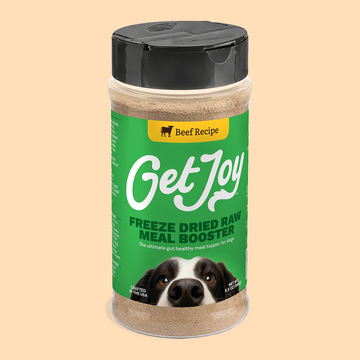
Get Joy's freeze-dried meals are built on exactly this principle. Every ingredient is named, sourced from real whole foods, and chosen for a reason. And built directly into every meal is Belly Biotics™ — a proprietary blend of prebiotics, probiotics, and postbiotics designed to support your dog's gut from the inside out. No artificial anything. No filler. No mystery.
Try Get Joy Freeze-Dried Raw Meals — real whole food ingredients with Belly Biotics™ built in. Shop Now →
From Get Joy dog parents
“I love knowing they’re made with clean ingredients.”
“Zero tummy drama.”
Customer reviews, shared as written
Ready when you are
Ingredients and guaranteed analysis for each recipe are on the product page.
Freeze Dried Raw Meals have Belly Biotics™ built in, store in the pantry and work as a full meal or a topper. 50% off your first Auto-Ship order. Skip, pause or cancel anytime.
Worried they won’t eat it? Mix a little into their current food and shift over 7 to 10 days. And we guarantee they’ll love it or your first order is free — that’s the Clean-Bowl Promise.
Frequently Asked Questions
Is "chicken by-product meal" the same as "chicken meal"?
No. "Chicken meal" is rendered chicken meat — a named, concentrated protein source that's acceptable in dog food. "Chicken by-product meal" includes parts like feet, heads, and intestines (though not feathers or hair) — it's more variable in quality and less transparent. When in doubt, choose foods where named whole meats appear first.
Are natural preservatives safe?
Yes. Mixed tocopherols (a form of Vitamin E) and rosemary extract are commonly used natural preservatives that are considered safe and even beneficial. They're a far better choice than BHA, BHT, or ethoxyquin.
Should I be worried about salt in dog food?
Small amounts of salt are necessary for healthy dog physiology. The concern is when salt appears high on the ingredient list or in large quantities — often a sign of lower-quality ingredients being masked. Look for foods where sodium appears naturally from whole food sources rather than as an added ingredient.
Is carrageenan in freeze-dried food?
Carrageenan is more common in wet/canned foods as a thickener. Most high-quality freeze-dried foods don't use it because the freeze-drying process doesn't require thickeners. If you see it on a freeze-dried label, it's worth questioning why it's there.
How do I know if a freeze-dried food has hidden additives?
Look at the full ingredient list, not just the front-of-pack claims. Ingredients are legally required to be listed in descending order by weight. If the list is long, vague, or includes any of the red-flag ingredients above, trust what you're reading — not the marketing language on the front of the bag.
Browse More Topics
Shop by Concern


Featured Posts
How to Transition Your Dog to Freeze-Dried Food
Freeze-Dried Dog Food for Weight Management
Freeze-Dried Dog Food with Probiotics: The Gut Health Guide