Bestseller
 Gut health
 Sensitive stomach
 Calm
Calm Joints & mobility
 Skin & coat
 Healthy weight
 Picky eaters



Last updated: May 2026
Key Takeaways
- Organ meats (offal) are the most nutrient-dense whole foods you can add to your dog's diet — more concentrated than any muscle meat.
- Liver, heart, kidney, green tripe, lung, and spleen each deliver unique vitamins, minerals, and enzymes that support whole-body health from the gut outward.
- Organ meats directly support gut health: tripe provides natural probiotics, liver supports bile production and fat digestion, and organ-sourced enzymes aid absorption.
- The safe feeding guideline is 5–10% of total diet by weight. More than 10–15% liver in particular can cause vitamin A toxicity.
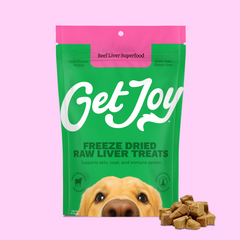
- Get Joy's Freeze Dried Beef Organ Treats are the easiest, safest way to add organ nutrition — no prep, no bacteria risk, just real nutrition in every bite.
Most Affected Breeds: All breeds; highly active breeds and growing puppies benefit most from organ meat nutrition.
What Are Organ Meats? (And Why "Offal" Has a Branding Problem)
Organ meats — also called offal — are the internal organs of an animal: liver, kidney, heart, lung, green tripe, and spleen, among others. They're what wild canids eat first after a kill, before the muscle meat. That's not coincidence. It's instinct backed by biology.
Domesticated dogs have largely lost access to organ meat because commercial pet food formulas are built around muscle meat, fillers, and synthetic vitamin supplements to make up the nutritional difference. The result: a lot of dogs are eating calorically adequate diets that are functionally nutrient-poor.
Organ meats fix that — with whole-food nutrition in a form the body actually recognizes and absorbs.
Why Organ Meats Are Nutritionally Superior to Muscle Meat
Muscle meat is a solid protein source. But organs are where animals concentrate the nutrients needed to run their most critical biological systems. Gram for gram, organ meats deliver:
- 10–100x more vitamins and minerals than muscle meat, in highly bioavailable forms the body can use immediately
- Complete amino acid profiles including taurine, which muscle meat often lacks in adequate amounts
- Fat-soluble vitamins (A, D, E, K) that require dietary fat for absorption — and are delivered here alongside natural fats
- Naturally occurring CoQ10, enzymes, and cofactors that synthetic supplements cannot fully replicate
Think of organ meats as nature's multivitamin — one where every nutrient comes pre-packaged with everything needed to absorb it. No synthetic fillers. No manufacturing shortcuts. Just dense, functional nutrition.
Organ by Organ: What Each One Does
Liver — The Heavy Hitter
Liver is the most nutrient-dense food on the planet — for dogs and humans alike. A small amount delivers:
- Vitamin A in retinol form (far more bioavailable than plant-based beta-carotene) for vision, immune function, and skin health
- Vitamin B12 at levels no plant food can match — critical for nerve function and red blood cell production
- Folate for cellular repair and DNA synthesis
- Iron and copper in heme form, absorbed at 2–3x the rate of non-heme sources
- Zinc for immune defense and coat health
Liver also supports bile production, which is the liver's direct contribution to fat digestion. Less bile means less efficient absorption of fat-soluble nutrients across the entire diet — not just from organs.
Important: because liver is so rich in vitamin A, it should not exceed 5% of the total diet by weight. More on this in the dosing section below.
Heart — The CoQ10 and Taurine Source
Heart is technically a muscle organ, which is why it's sometimes miscategorized as muscle meat. Nutritionally, it functions like an organ — and it delivers two nutrients that are worth paying close attention to:
- CoQ10 (coenzyme Q10): A cellular energy compound critical for heart function, mitochondrial health, and antioxidant activity. CoQ10 declines with age — and dietary heart is one of the few natural ways to replenish it.
- Taurine: An amino acid linked in studies to dilated cardiomyopathy (DCM) prevention in dogs. Grain-free diets have been flagged in DCM discussions; taurine-rich organ meats like heart may help offset that risk.
- B vitamins (B1, B2, B6, B12) in concentrated form to support energy metabolism and nervous system health
Kidney — B12, Selenium, and Omega-3s
Kidney is rich in:
- Vitamin B12 (nearly as concentrated as liver)
- Selenium, a trace mineral that supports thyroid function and acts as an antioxidant alongside vitamin E
- Omega-3 fatty acids, including EPA, which support skin, coat, and inflammatory response
- Iron in highly absorbable heme form
Green Tripe — The Gut Health Organ
Green tripe is the raw, unprocessed stomach lining of a ruminant animal (cow, lamb, bison). It is not the bleached white tripe sold for human consumption. It is fermented rumen — and it is one of the most gut-supportive foods you can give a dog.
- Natural probiotics: The fermentation process in a ruminant's stomach produces beneficial bacteria that transfer directly to your dog's gut microbiome
- Digestive enzymes: Amylase, protease, and lipase to help break down carbohydrates, proteins, and fats — reducing the burden on your dog's own digestive system
- Near-perfect calcium-to-phosphorus ratio (1:1) for bone health without supplementation
- Lactobacillus acidophilus, one of the most studied probiotic strains for canine gut health
If there is one organ meat most directly connected to gut health, tripe is it. It does not just deliver nutrients — it actively improves the environment in which all nutrients are absorbed.
Lung — Concentrated Heme Iron
Lung is lower in overall fat than liver or heart, making it a leaner option that still delivers concentrated heme iron for oxygen transport, red blood cell production, and sustained energy. It also provides a good source of vitamin C, which is unusual for an animal-sourced food.
Spleen — The Iron and Zinc Powerhouse
Spleen has one of the highest iron concentrations of any organ — even higher than liver in some analyses. It also provides zinc, B12, and protein. For dogs prone to anemia or with high energy demands, spleen is a valuable addition to the organ rotation.
Real Organ Nutrition. No Prep Required.
Get Joy's Freeze Dried Beef Organ Treats deliver real liver, heart, kidney, and lung nutrition — freeze dried for safety and convenience. Pair with Belly Biotics™-powered meals for a gut-first routine.
Shop Organ Treats Shop Freeze Dried Raw MealsThe Gut Health Connection
Most conversations about organ meats focus on individual vitamins and minerals. That's useful, but it misses something more important: organ meats don't just feed a dog — they improve the digestive system's ability to absorb everything else.
Here's how organ meats directly support gut health:
Liver and Bile Production
The liver produces bile, which is stored in the gallbladder and released into the small intestine to emulsify fats. Without adequate bile production, fat-soluble vitamins (A, D, E, K) — including those from organ meats themselves — cannot be properly absorbed. A nutritionally supported liver is a better-performing liver. Feeding liver supports the organ that enables fat digestion across the whole diet.
Tripe and the Microbiome
A healthy gut microbiome depends on a diverse, well-fed population of beneficial bacteria. Green tripe introduces live beneficial bacteria alongside the prebiotics those bacteria need to establish and thrive. Unlike isolated probiotic supplements, tripe delivers this in a whole-food matrix — with proteins, fats, and digestive enzymes that help the bacteria survive the journey through stomach acid.
Enzymes That Reduce Digestive Load
Dogs produce their own digestive enzymes, but that production capacity has limits — especially in older dogs, dogs on processed diets, or dogs with chronic digestive issues. The naturally occurring enzymes in raw or freeze dried organ meats supplement what the body produces, reducing the digestive workload and improving nutrient extraction from everything else in the meal.
Cofactors That Enable Absorption
Many vitamins and minerals require specific cofactors to be absorbed and utilized. B12 requires intrinsic factor. Iron absorption improves in the presence of vitamin C. Zinc and copper compete for absorption — and organ meats deliver them in ratios closer to what the body expects. This whole-food nutritional matrix is something synthetic supplements cannot replicate, no matter how sophisticated the formulation.
Gut health is the starting point for whole-body health. Organ meats — and the functional nutrition built around them — are how you get there from the bowl.
How Much Organ Meat Is Safe to Feed?
The general guideline: organ meats should make up 5–10% of your dog's total diet by weight.
Within that range:
- Liver specifically should stay at or below 5% of total diet weight. Liver is so dense in vitamin A that overfeeding can cause hypervitaminosis A — a genuine toxicity concern that presents as bone pain, lethargy, and in severe cases, skeletal deformities. This is not a theoretical risk. It is real and documented.
- Heart, kidney, and lung can make up the balance of the 5–10% organ allocation without the same toxicity concern, since they're lower in vitamin A.
- Green tripe can be fed somewhat more liberally — up to 10–15% of the diet — because it does not carry the vitamin A concentration of liver or spleen.
If you're feeding a complete and balanced meal (like Get Joy's Freeze Dried Raw Meals), organ meats are likely already incorporated at appropriate levels. Additional treats or toppers should be factored into the total organ allocation, not added on top without consideration.
When in doubt, start conservatively — a small amount several times per week — and watch for digestive changes. Some dogs, especially those new to organ meats, may experience loose stool when transitioning. Introduce slowly.
Get Joy's Freeze Dried Beef Organ Treats: Convenient, Safe, Nutritionally Intact
Sourcing, preparing, and portioning raw organ meats at home is genuinely complicated. Raw organs carry bacterial risk (Salmonella, E. coli, Listeria) that makes handling and storage a real concern. And measuring 5% of total diet weight requires more precision than most dog parents want to deal with at 7am.
Get Joy's Freeze Dried Beef Organ Treats solve all of that.
Freeze drying removes moisture without heat, which means the nutritional profile of the raw organ meat is preserved — vitamins, enzymes, CoQ10, taurine, and bioavailable minerals all intact — while eliminating bacterial risk. The result is a shelf-stable, easy-to-portion treat that delivers real organ nutrition without the prep work or the worry.
- Real beef organs — liver, heart, kidney, lung — not flavoring, not by-product meal
- Freeze dried for nutritional integrity — the benefits of raw, without the bacterial risk
- Single ingredient, no fillers — grain-free, gluten-free, nothing added
- Portion-controlled — easy to use as a training reward or meal topper without overfeeding
Used alongside Get Joy's Freeze Dried Raw Meals — which already include Belly Biotics™ for consistent gut support — organ treats are the natural way to deepen the nutritional routine without adding complexity.
Better nutrition for them. Simpler routine for you. That's the whole idea.
FAQ
Can I feed my dog organ meat every day?
Yes — as long as total organ meat stays within 5–10% of total diet weight. Daily small amounts as a treat or topper are fine. Daily large amounts, especially of liver, can exceed safe vitamin A levels over time.
What's the best organ meat to start with?
Heart is the most forgiving starting point — it has an excellent nutritional profile (CoQ10, taurine, B vitamins), lower fat than liver, and no vitamin A toxicity concern. Green tripe is another excellent first choice specifically for gut health support.
Is freeze dried organ meat as nutritious as raw?
Yes. Freeze drying preserves the nutritional profile of raw organ meat far better than cooking, which degrades heat-sensitive vitamins and denatures enzymes. The main things lost in freeze drying are moisture and bacterial risk — both of which you want to lose.
Can puppies have organ meat?
Yes, but keep portions smaller relative to body weight, and be especially careful with liver. Puppies are more sensitive to vitamin A toxicity because they're smaller and their systems are still developing. Consult your vet on appropriate amounts for your puppy's size and breed.
My dog has never had organ meat — will it cause stomach upset?
Possibly at first. Organ meats are rich and unfamiliar, and some dogs experience loose stool when transitioning. Introduce slowly — one organ type at a time, in small amounts — and increase gradually over 1–2 weeks as their digestive system adjusts.
Does Get Joy's food already include organ meat?
Get Joy's Freeze Dried Raw Meals are formulated with whole food ingredients for complete and balanced nutrition. The Freeze Dried Beef Organ Treats are specifically designed to add targeted organ nutrition on top of the meal foundation — as a treat, training reward, or topper.
Start with the gut. Feed the whole dog.
Get Joy's Freeze Dried Beef Organ Treats pair perfectly with Belly Biotics™-powered meals for a routine that supports your dog from the inside out.
Shop Organ Treats Shop Freeze Dried Raw Meals